
UKGE 2026: Post Con Deconstruction
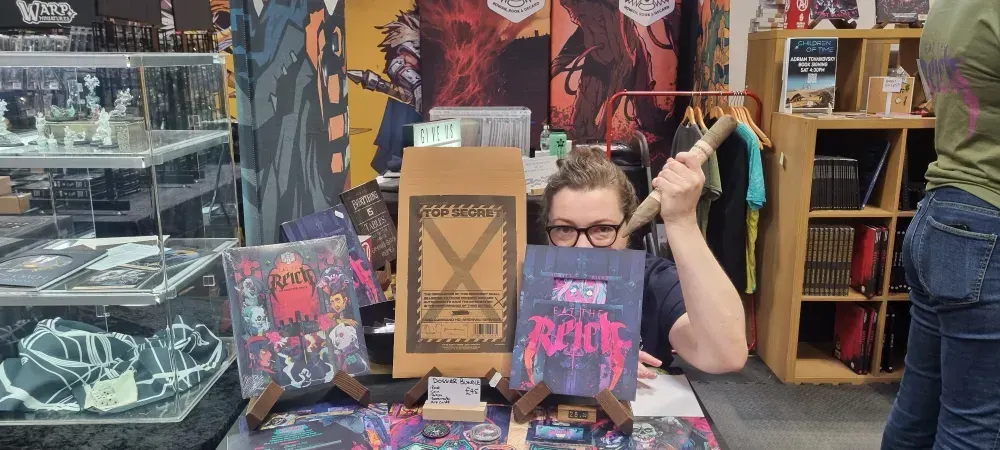
With one more UKGE under our belt - the sixth, I think? Covid made it hard to count - it seems like a good moment to share some of our stats and talk about how we run the convention. There’s a growing tradition of post-UKGE roundups from small TTRPG creators, and as a medium-to-large TTRPG creative business (which is still a very small business in the context of, you know, businesses, and the UKGE halls themselves), we thought it might be interesting for folks to see how these things change as we scale up.

The Stall
Last year, we had a 5m by 6m booth with a giant pillar in the middle. It was OK, but the giant pillar did prevent us from making full use of the space, so this year on rebooking we went with 7m by 4m but without the pillar.
For a couple of years now, in the UK, we’ve been using a stall concept that started out being called “The Well Thumbed Library” and is now known as “books on bookshelves”. It consists of an assortment of Ikea Kallaxes (Kallaxen?) that we nailed together with the company nailgun in the basement of the Hammersmith Novotel before Dragonmeet one year, and that we store fully assembled on pallets in our longsuffering warehouse to avoid having to remove the nails again. We claim it’s for longevity.
(This is one of the options that you get from working with a warehouse, rather than storing your stock in a garage: the ability to say “yeah we’ll pay a few quid each month to avoid having to completely reassemble a large living room’s worth of shelving four to eight times a year”. It’s a luxury, but we don’t do cons on a shoestring, because the value isn’t in shaving all our costs down to an absolute minimum.)
What the Kallaxen give us is a modular set of cubes that we can arrange in various configurations. With a larger stall, we have the opportunity to pull people in - to design the stall in such a way that it invites them to linger a little while in our space, and while they’re there, maybe buy something? We’ve found it’s easier and more interesting for most people to browse, and it lets us display our wildly disparate stock of game titles in a way that feels coherent (because they are all books on bookshelves, after all).
So a few weeks before a convention, normally Matt gets out a Google Sheet with a bunch of colour coded squares and plays around with where we put the furniture. One Kallax cube is about a foot, which is convenient, so you can put together a top-down plan where 1 square = 1 square foot, and go from there, thinking about things like leaving 1m between furniture for wheelchair accessibility and building for the sightlines we expect to have into the stall.
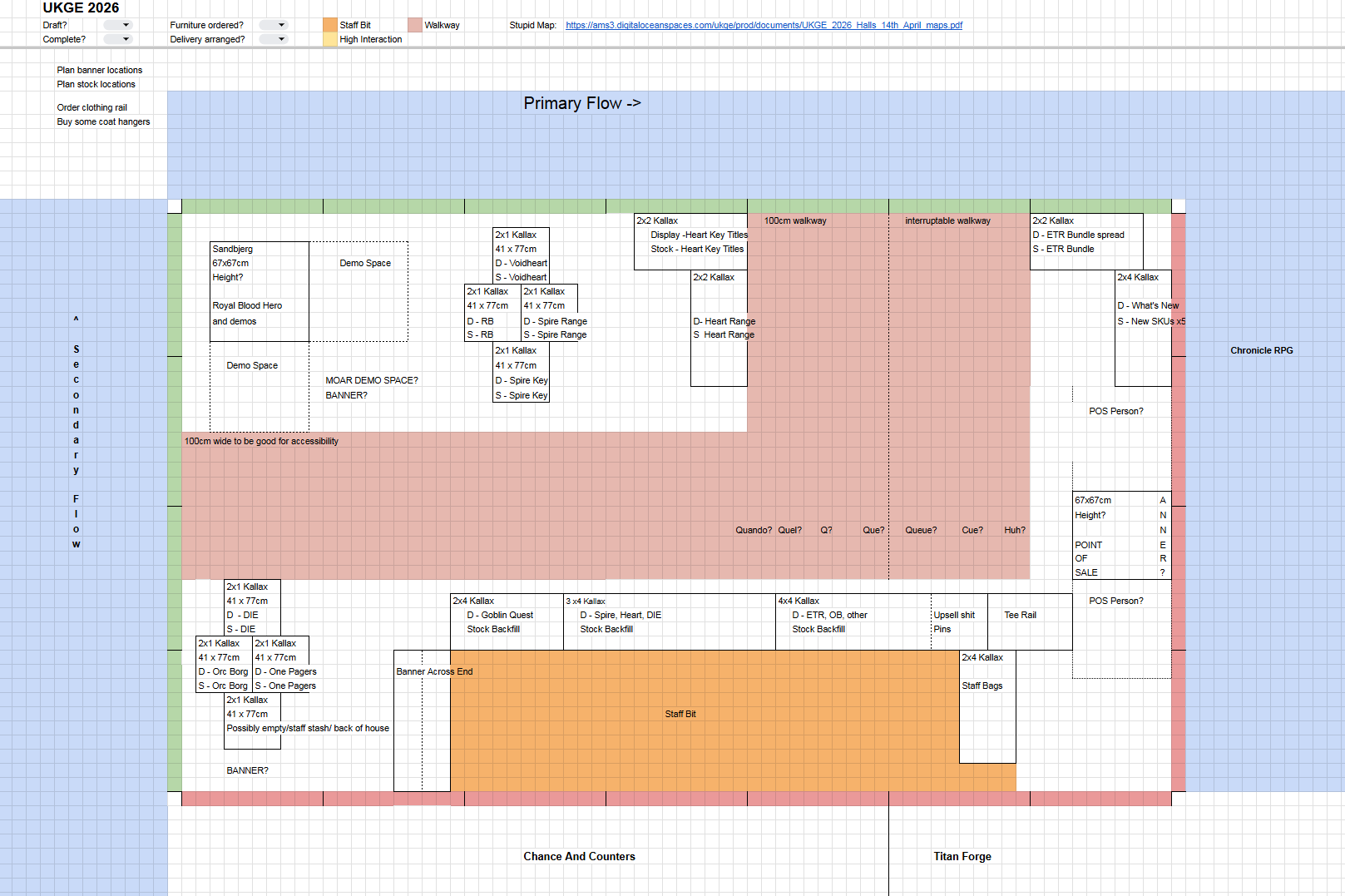
This year, for the first time, we plotted out which books should go on which shelves before we got there - this plan mostly survived contact with reality, but when we were checking out angles of approach before the con opened, we added some more display copies on the outer edges and made a New Things shelf on one corner. One of the challenges with a corner stall is getting a copy of everything that people might be excited about visible from every angle. I don’t think we’ve completely solved this yet.
We’re also unusual in that we focus a lot on making the product visible, rather than the banner ads or the branding; some years that works well (Eat The Reich year was a very good year, because of this) but other times we might be better served by letting some branding do more work. We do have some banners, but tend to use them more for blocking sight lines to the Secret Bit Behind The Big Kallax Where The Staff Can Hide And Eat A Halloumi Wrap In Peace.
This year we tried a fixed point of sale on one side of the stall, which worked really well. Without that, and sometimes without staff shirts in the past, we’ve had customers confused about where to pay or queue. There’s utility in having floating people able to take immediate payment, but we found this way people could shop without needing sales support if they already knew what they wanted, and it helped keep the stall flowing sensibly.
This year, unlike the past two years, we didn’t go for a sponsorship package. We decided against it after struggling to get a response from both the NEC and from UKGE on issues around safety for trans and intersex people at the expo, particularly around bathroom safety. We were very pleased to see that gender neutral toilets were available at the event, in the end; we did offer to sponsor and provide a gender neutral piss bus but for some reason the organisers said no. We may go back to the sponsorship next year, depending on how things evolve; it’s definitely the case that having your logo on the map helps people to find you, because the hall is very badly organised (more on that later) and even knowing a booth number isn’t usually enough to make finding a stall straightforward.

Demo Table
We’ve got an uneasy relationship with demos. We know they work well for board games, but we’ve seen so many poor ones for TTRPGs that we’ve tended to shy away from them, especially for our more story-driven games where getting people into the vibe is a challenge if you’ve only got 20 minutes in a hot and noisy hall.
But we’ve been working on it. Two years ago we had a very fancy Hollows demo table: it worked well for the, what, 18 people we could actually serve with it, but it was also in the way most of the time and didn’t really translate to much. Last year, we introduced character generation sessions for Spire and Heart, which did help get people into the idea of the games. And this year we had the Royal Blood Demo Table, which was vastly improved by Naomi and guest star Nathan Blades both making it look the part and doing a fantastic job of reading tarot for passing punters and showing the game at the same time.
Royal Blood is new to the stall this year, which usually predicts better sales, but it’s a high price point box game in a world that’s increasingly geared towards low price point solo games, so we weren’t sure how it would do. It was about 12% of our stall footprint but made up nearly 20% of sales; we think that’s down to the demos working.
When you combine that with the thoughts we’re having about stall and branding, there’s a good chance that next year we’ll have more demo/browse options where people can get a real sense of the vibe of the game, not just how it looks as a book. If we can fit them onto the stall sensibly, that is.
Staff & Stock
Not counting the demo table, our stall takes about three people to run well: one on point of sale and two floating, chatting with people and discussing what they might want to buy. TTRPGs in general actually don’t do a great job of selling themselves, unless you’re D&D; people want to ask questions. Especially at UKGE, which is a general-interest tabletop convention where the vast majority of people are not interested in a roleplaying game at all. Our booth is large and inviting enough to attract general interest customers, which means a fair few folks are coming in who want to find out what this thing is and whether their board game group would even be interested in it.
We try to rota people on the stall for half day shifts, rather than a full day. We find a lot of people still want to come and hang out on the stall intermittently - it’s good to have a base of operations to work from in a busy con - and we tend to end up well staffed. Crucially, this means people can come to the convention as a whole, not just see it as a busman’s holiday where they’re working every hour and unable to actually join in.
This year we were also lucky to have social media wretch Naomi on standby to take photos, run demos and share video from the con. Originally Naomi had half a dozen panels planned, including with guests, but we were relatively late submitting them and unfortunately UKGE lost them between approval and scheduling, and it was too late to get them back in once the issue was discovered. Ah well. Next year for that.
We keep things like painkillers, snacks, and throat sweets behind the stall along with the normal first aid stuff. Pro tip - if you’re ever at a con and need a blister plaster or a Sharpie, come see us.
Most of our UK stock is stored at a warehouse in Wellingborough, with our 3PL partners, and each year we hire a van (or a man with a van) to bring it to Birmingham on Thursday, and pick up what’s left on Sunday. This year we did run into a small issue when the Sunday van got stuck at the scene of a massive accident which closed the M6 in both directions for several hours. Luckily, we found a solution to get our goods out again that didn’t involve waiting at the NEC till Monday. Poor Dariusz might still be on the M6 for all we know; we hope he’s okay.

We also brought in some new staff shirts this year - logo on the front, game art on the back - for Spire, Royal Blood and ETR. There’s coherence in having the logo there, which helps people spot the team - we tried something with waistcoats one year, which absolutely did not work, and then we were all in black logo shirts for a bit, which felt. Well. A bit too boring. We don’t think we’ve found the right vibe for this yet, but this year was definitely better. Respect to the Doomsong folks who turn up in full cassocks; with 10 total team members that’s an outlay and commitment we can’t currently match, but there’s got to be a more interesting mid-point.
Accommodation & Transport
Because Maz grew up in Solihull and their parents still live there, each year, RR&D stays with them. This is something of a tradition now, and Jean and Malcolm are part of the crew: they’ve been part of our UKGE experience since there were only three of us stall-sharing with the UK Indie RPG League, and they’ve been very gracious ever since about sharing their space, even when we’ve accidentally had pallets delivered to their cul-de-sac.
We pay Jean and Malcolm a stipend for laundry and use of the house, because these days there are seven or eight of us each year and that’s a lot of disruption for a couple rapidly approaching their 80s, even if they do enjoy the diversion. One of the joys of this setup is that we have a shared space to come back to at the end of the day and the end of the convention; we now have a traditional team takeout on Thursday night before things kick off, and a beers-in-the-garden post-con Sunday for those who don’t want to add travel on that day. It helps the convention feel like fun, which is something that matters a great deal to us; I think if we didn’t have family to stay with, we’d still go for an Airbnb or something similar that would let us keep that vibe, as we have done with Gen Con in the past. We work fully remotely, with folks based all over the UK (plus Mina in the USA), so conventions are one of the few times that a lot of us can meet up and hang out, so this kind of thing matters a lot.
Within that, we all sort our own transport to Solihull - trains for most people, cars for a few - and then drive in each day in shifts. Stall staff can claim all their transport costs back, either as direct reimbursement for train tickets or a mileage rate for car travel. Food is a mix of shared meals and personal choice: we always bring a couple of boxes of Huel for stall lunches, which might sound like a punishment rather than a treat, but with a majority-neurodivergent team - many of whom simply forget to eat on a regular basis - having food you can drink absent-mindedly is a real help.
Plus, because of our setup, Grant cooks a full cooked breakfast for everyone who’s awake every morning at 8am. This makes everything much better and allows Grant to both be dadly and protective of the team, and to go back to sleep for a couple of hours in the knowledge he has done his duty.

Sales & Stats
So, this section is partly why this roundup is happening today and not at the start of the week. The bigger you are, the more staff expenses you have to mop up and the more you’re getting services from third parties like man-and-van-hire, the longer it takes for the dust to settle on your finances so you can really get a sense of what’s been spent.
Speaking of which, we spent a total of about £6,400 in direct costs. That breaks down as roughly £3,600 on the booth space, getting stock to the convention, and stall dressing, with the other half being pay for contractors, food, staff travel and new T-shirts.
These figures don’t include the costs of the stall furniture, which would be about £1000 all in if we bought it today; that cost is amortised over the years it’ll be used, so we do have to consider it as part of our broader convention budget. (It’s another reason to keep it all assembled: the more you construct and deconstruct a Kallax, the shorter its shelf life becomes.)
Staffing also muddies the waters. This year we brought seven RR&D staff, and had three non-staff booth folks of various kinds. We pay our booth staff in actual money; for RR&D folks, there’s time off in lieu for those who work cons, which also works out as actual money but requires more creative maths to show how much. We don’t require anyone to work the convention if they don’t want to, or can’t.
In total, we took about £15,200 including VAT - about £14,600 when VAT is taken off. We mostly sell books, which are zero rated for VAT, but we do sell some other things and that does make a difference. We were down a little on last year’s total, but well up on every other year, and about in the middle of where we were expecting to land. We didn’t sell out of anything, but we sold through a good bunch of what we brought.
(One year we had to get a bunch of Eat The Reich emergency-delivered to the North 12 lorry park on Saturday when it was closed, and then smuggle them into the con in suitcases, so this year was at least less eventful.)
We were down on total number of sales from last year but up on revenue-per-sale, which makes sense - lots of people already own Eat The Reich, which is our biggest selling small product, and our new games have a higher price point. We were also pushing bundle sales this year, with new supplements for Heart, and the Magnificent Box for Royal Blood all pushing the price point up. We could definitely have made more sales by focussing on the lower priced products, but at the expense of some of our margin. There are some holes in our product line (solo games in particular) that we could and maybe should have a go at filling, but we only make games we’re really excited to make, so it might be a wee while before that happens organically. We also didn’t bring any third party games with us this year, aside from the excellent Heartsong supplement.
At our size, though, revenue isn’t enough to understand profit. All our games cost something to make, and some carry royalty agreements that mean we pay a percentage to creative partners. Factoring in the costs of what we’ve sold, fees on card payments and the royalties involved, we made a total of about £10,100. That nets off against our obvious costs, and works out at around £3,700 in profit.
Convention sales are some of our lowest margin sales, even with the savings we make on accommodation at UKGE - the staffing costs and the booth costs make a big impact there. But it’s not all about the sales floor.
The Other Stuff
Customer sales are a big part of why we do UKGE, but they’re not the whole of it. It’s also a massive opportunity for face time with current and potential partners, and for socialising with people we otherwise wouldn’t see much or at all. There are other shows where this is the entire point - the GAMA trade show in the US, for example, or the way we do London Book Fair primarily as a way to connect with printers and book trade partners - but at UKGE it’s generally happening alongside the consumer show, and without a dedicated space for it.
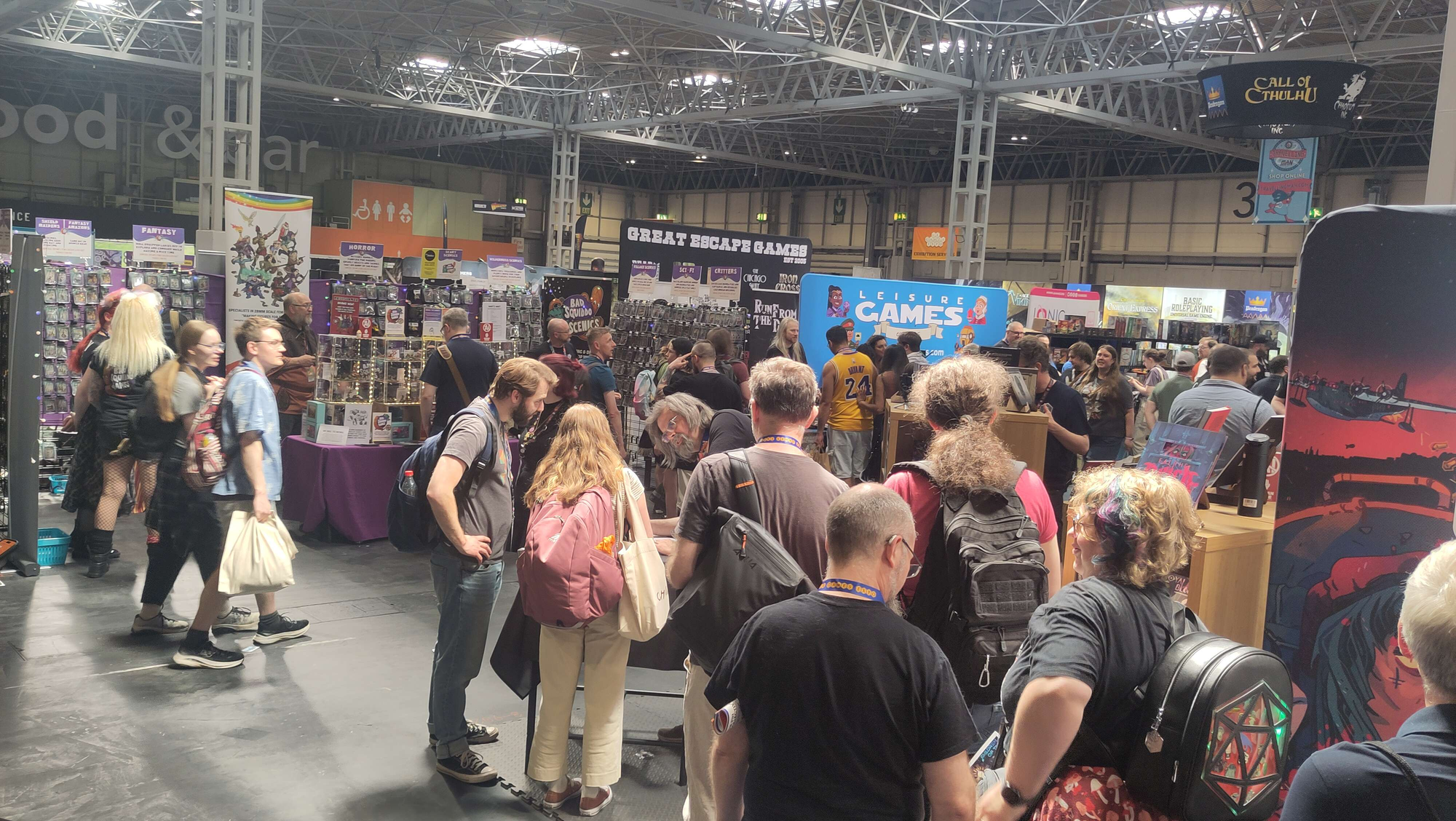
UKGE is an odd duck, in terms of how it chooses to organise the trade hall. Booths are often popped in alongside each other without much of an eye to theming or navigation, or whether it makes any sense to - for instance - put a trade logistics firm in a prime spot just inside the entrance to Hall 3, or install a manufacturer (who displays game samples but does not sell them) right next to a hobby shop (which sells the same games). The experience would, we think, be dramatically better if it worked more like Essen Spielmesse, where there is usually a trade hall dedicated to business-to-business booths, a manufacturer zone, and a business area where you can get bad coffee and take meetings.
Maz is the main meetings person at the con, and this weekend they took a total of 23 diaried meetings plus another half dozen or so that came up incidentally. Not counting networking events or parties. This is not normal behaviour in everyday life, but for three days a year, it’s manageable. Because of the aforementioned lack of a business zone, most of those meetings took place in a crowded cafe, a crowded smoking area, or simply standing up in the hallway, where a lovely NEC security guard took the piss out of Maz for not doing enough work.
This year those meetings were a very rough split between:
- Manufacturers: 20%
- Crowdfunding platforms & marketing partners: 15%
- Distributors: 12%
- Industry chat: 30%
- Collaboration & licensing: 23%
The “industry chat” category there is the vaguest, but also often the most interesting. It’s where you find out how stuff is going for other people and other companies, get a sense of trends or opportunities. It covers going to chat with the new COO at GAMA to find out about her ideas for improving the trade body, or meeting a counterpart at another publisher to see how their projects are going, or gossip. There’s always gossip: this industry is very, very narrow, and everyone knows everyone, and sometimes that gossip is immensely helpful in giving you a steer on a working relationship, or an approach to a problem, or an insight into something behind the scenes somewhere that helps you get a better handle on a wider issue. There is no way to put a value on building and maintaining relationships with people in the industry, and often the most fruitful relationships are born from random meetings or from friendships that develop over time and only become opportunities to work together after months or years.
But some things you can place a value on. By our current estimates, somewhere between £25,000 and £150,000 will come out of a combination of these meetings over the next 6 to 24 months. Between print runs, marketing spend and crowdfunding, we’ll spend a five figure sum with partners we met during the expo as well. Money moves in much bigger lumps behind the scenes than it does on the con floor.
Also? Some relationships are just good to have in a crisis, and you can’t always predict which ones. When we were stuck in the hall on Sunday evening with eight pallets of furniture and Matt had a chat about it to David and Dan at Spiral Galaxy, we weren’t expecting them to say “hang on, let us check our three articulated lorries and see if we can help you out”. But this is an industry composed, mostly, of really pleasant people who want to help when they can, and we’d like to thank Spiral Galaxy for the loan of eight pallet spaces and the ability to leave the hall almost on time.
The Other Other Stuff
Look, we don’t really do conventions to make fat stacks of cash from sales. There was a time when we were small and scrappy enough, and the impact big enough, that UKGE was a meaningful spike in our income for the year. It’s not nothing now, but it’s not what we live or die by: a big distribution month can bring us triple our con income. The money is nice, and it’s important that we try to break even, but really we do conventions for other reasons.
A few years ago, when Matt started to pick up more responsibility for our convention presence, we started a spreadsheet to measure the other reasons. There’s a common business adage that what you care about is what you measure, and vice versa, so we decided to measure the intangibles that we care about.
Usually these are:
- Sell to people we can’t normally reach
- B2B networking opportunities
- Con enjoyability for staff
- Developing our con presence
- Teambuilding
- Product testing
- Wholesale
We measure them all on a scale from 1 to 5, and it’s what informs things like “should we do Airecon again this year even though they stuck the trade hall in a cupboard last time” and “is Norwich Games Con worth doing just for the fun of it even though it’s got a max reach of 1,000 people” and so forth.
We think there’s also another intangible, which is: it’s just so good to talk with people. We spend 98% of our year quietly hidden behind our computers, assuming that Discord and Bluesky are meaningfully representative of the actual real people who pick up and play our games, who care about our industry and who love (or really, really hate) what we do. Getting out of that bubble and into a different bubble for three days has value beyond value. At UKGE in particular, where Grant gets to hold court and talk about his games with dozens of people, where we all get to gush about what we love and be proud of these beautiful things we’ve made, and then we get to go have a quiet lie down in a nice garden afterwards - it’s one of the best weekends of the year.

What else?
So this is already 4,000 words long. It’s the first time we’ve done a round-up like this and there’s lots more we could talk about. What would you be interested in knowing? Message us and let us know.