
SALT design diary: this is how we Role
What makes Salt: The City Adrift different from Heart and Spire, set in the same world? Aside from all the seawater?
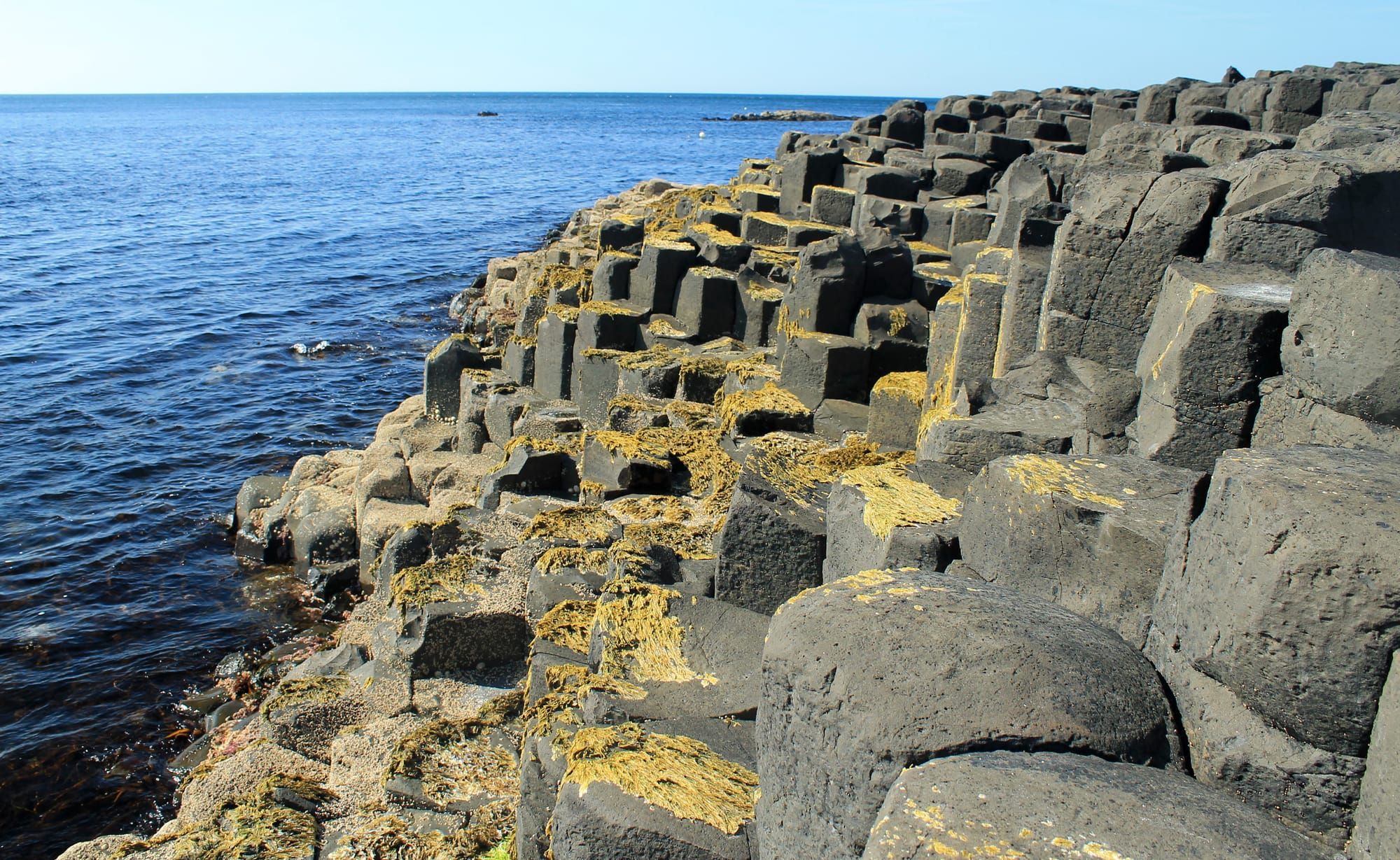
We're reaching an exciting stage on our new game: we've just begun internal playtests of SALT: THE CITY ADRIFT, a thalassic body horror game in a once-sunken city, set in the same world as Spire and Heart. While Chris runs sessions, Grant has written one of his occasional design diaries to explain a bit more about the game as it currently works.
How is Salt different from Heart and Spire?
We’ve been working on Salt for bloody years (and will continue to do so until it’s ready) but, as we approach our second internal playtest, I felt it was time to give you lovely people an update on where we’re at with it.
Salt is a sibling game to Heart and Spire. It's set in a honking massive cyberpunk Atlantis that bobbed up out of the ocean about eighteen months before the game begins. As this city was built by the Prokatakos, the forerunners that also (presumably) built Spire, the Heart, and any number of buried eastern arcologies you care to mention, the implications of its sudden emergence and the relevance it has to the rest of the world are massive.
When you write a new core book in a world where you’ve already established some truths, there’s a balancing act in play. On one hand, you want to make sure that the experience is familiar enough to folks who’ve played the other games so it feels like part of the same world - Chris, in particular, has been very keen that a) we use the Resistance system in any game set in the same universe as Spire, and b) we make as few changes to it as possible. (I think this is because he appreciates that the game works just fine as it is, and also as a means of curbing my more dramatic excesses when it comes to revising the core design.)
(If I’d have had my way, Heart wouldn’t use numbered stress at all.)
On the other hand, you want to make sure that the game feels different enough that it isn’t just a rehash of old material. Heart definitely feels different to Spire, but when we did our first playtest of Salt earlier this year, Chris said that it was good - it all worked - but it felt exactly the same as Heart. We were just playing Heart on a boat. Something about the high weirdness of the characters - a priest of dead gods, a half-machine engineer, a luck-cursed gunfighter and a priest of the high elven sun pantheon - made it feel too similar.
The tagline for Salt - not the actual subtitle, but the phrase that we’ve used to reorient ourselves during the development process, asks for an experience that is not as friendly as your standard Heart campaign.
YOU WILL NOT UNDERSTAND THIS MACHINE.
YOU ARE THE RATS IN THE WALLS.
And, of course, Heart isn’t that friendly - it still wants to kill you. But it’s worked out that death is probably what you want, just the right kind of death, and it tries to offer that to you in the most dramatically satisfying method possible. (For those of you not in the know, the Heart is conscious like a mushroom is conscious and it loves you in a Lenny from Of Mice and Men kinda way.)
So, eager to hold off on the weirdness and emphasise the strangeness of the city in comparison to the player characters, we introduced Roles.
What are roles?
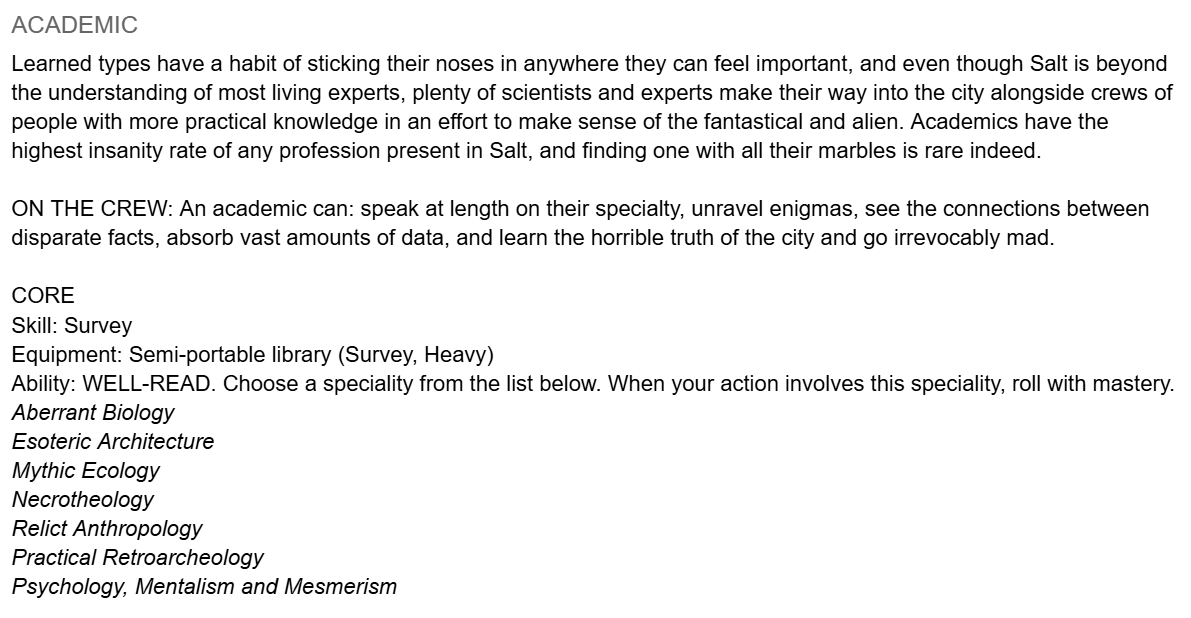

Roles are your job - honestly I might change the name to Jobs for ease of reference - and they’re a measure of your more mundane abilities. With Spire, you’re assumed to be part of a resistance cell; with Heart, a gang of dungeon-crawling delvers. We knew we wanted people to have a boat in Salt, and that they’d be part of the crew of said boat, but the more we sat with it the more it felt like the player characters weren’t great crewmates. I don’t know much about sailing, but I’m pretty sure you’d get a guy who can do knots and maybe someone who can read a map reliably before you’d put out an ad for any priests of any dead gods you care to mention.
When you start play in Salt, you don’t have a class; you just have a role. You work towards your class over time, and through play. We have eleven or so roles at present, and they cover a bunch of the more useful professions in terms of trying to make a living by ransacking an impossibly huge cursed city: diggers, academics, divers, hunters, captains, and the occasional mercenary.
The format for writing up roles was inspired by Burned and Broken, my favourite Heart supplement that no-one’s ever played. (As far as I’m aware. I’d be happy to learn that I’m wrong.) In Burned and Broken, you play Ministry operatives who were cut loose by their previous employer and forced into hiding in the City Beneath. It was originally intended as a fairly by-the-numbers conversion between Spire and Heart, but almost as soon as we started we figured out that it wouldn’t work at all. Spire, a game about - effectively - one or two audacious gambits per session and a lot of scheming in the background, didn’t map to the death march trudge of Heart, so we scrapped the idea of trying to faithfully convert characters from one system to the other and instead mangled all of our Spire classes into grubby sawn-off versions suitable for entry into meat hell.
I was very fond of those little packages of abilities - it was a fun challenge to make the (often rather wordy and elaborate) Spire classes fit, and the conceit of being sold out by the Ministry meant that we didn’t have to worry about every little detail coming across. They were out of their element, and forced to operate as best they could with limited resources and experience.
Just like the roles in Salt!
Advancement
We still have Beats - fun goals for the player, not the character, that allow for advancement - because I know a good thing when I steal it from Marvel Heroic Roleplaying and I’m not about to change it. At present, each class has its own set of Awakening beats which you select at character creation and, when you clear enough of them, you gain access to the class’ core abilities and potential advancements. That means that while you know that your chap is destined to be, say, a half-fish half-man Benthic Scion, he hasn’t got a bloody clue what’s in store for him.
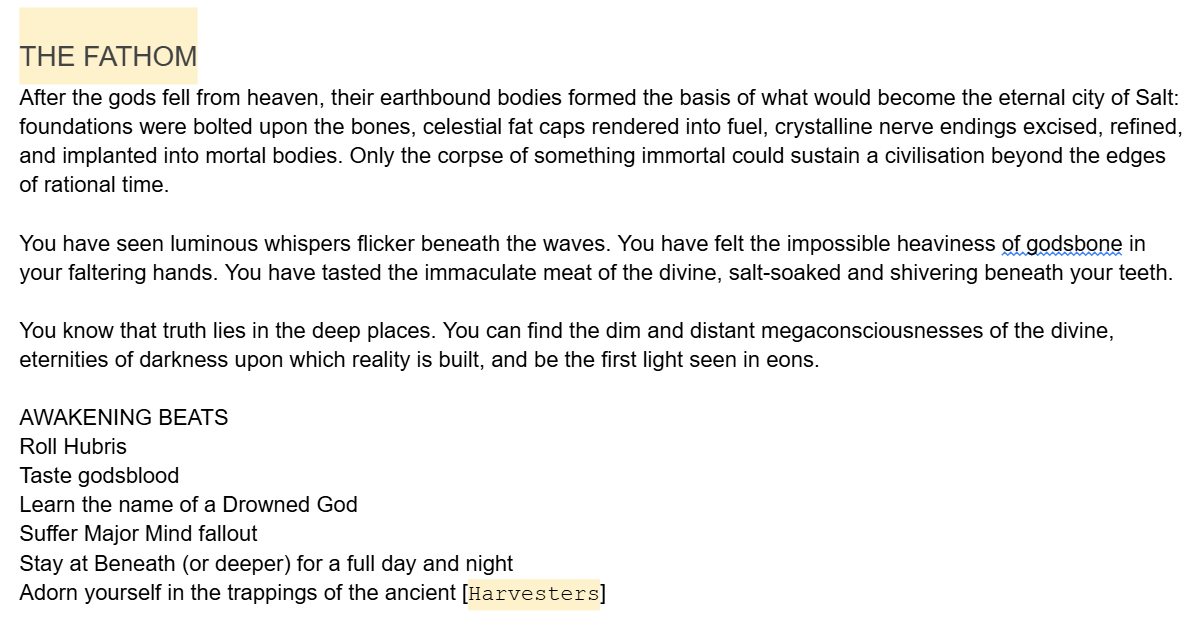
I’m not sure how I feel about that right now. I appreciate having the control over your character from the start, especially if you have a neat idea in mind or a class you especially want to play, but there’s something appealing about not knowing what’s in store for you at all. I’m not sure how we mechanise it without getting a bit clunky and inelegant, but I suspect there’s a route that could let us - say - tag Beats with keywords, and you could pick any class that matches them?
It feels a bit more Rats in the Walls, anyway.
It's all still in flux
Everything’s still up in the air - Salt is, as Producer Elaine put it, in an embryonic state right now. And it’s a very old embryo, for sure, but there’s still the potential to unmake the whole lot and try something else if we feel like it would make a better game. I’m glad we’ve got the opportunity to do that, and that’s one of the reasons why I’m so happy and proud to have RRD behind us when it comes to making sure our games are as good as they can be (and not just, you know, on time).
I’ll keep you updated with more as the game develops. We have session one of our internal playtest coming up on Thursday; I’m playing a drow Digger from Spire, a third-generation Holesman with a background amongst the lunatic platemail mudlarks of the North Docks, and I have a suspicion I’m going to find a magic coin which will completely fuck my life up. Only time will tell.
Next time I want to talk about the profit system Chris has worked out that forces players to strip the copper wiring out of Atlantis if they want to afford food this month. Or the (mostly) inferred mad culture of the last and only Prokatakos megalopolis where they outlawed death, and what that meant for the people who weren’t wealthy enough to circumnavigate the law. Or the Jurist class, who makes all their own spells out of fragments of legal documents and has to etch them on massive stone tablets or suffer permanent Mind stress from keeping antediluvian precedent straight in their mortal brains. Or the multiple Storm tables that start off with “a mild breeze” and finish with telegraph-pole sized shards of smoking glass plunging into the basalt.
There’s a lot to love, is what I’m saying.
- Grant “How Many Subsystems Can We Fit In A Single Game” Howitt