
Do Open, Dead Inside
How do you create a ghost story that people can play through? How do you tell a story through locations and surroundings, not just exposition and big monsters?
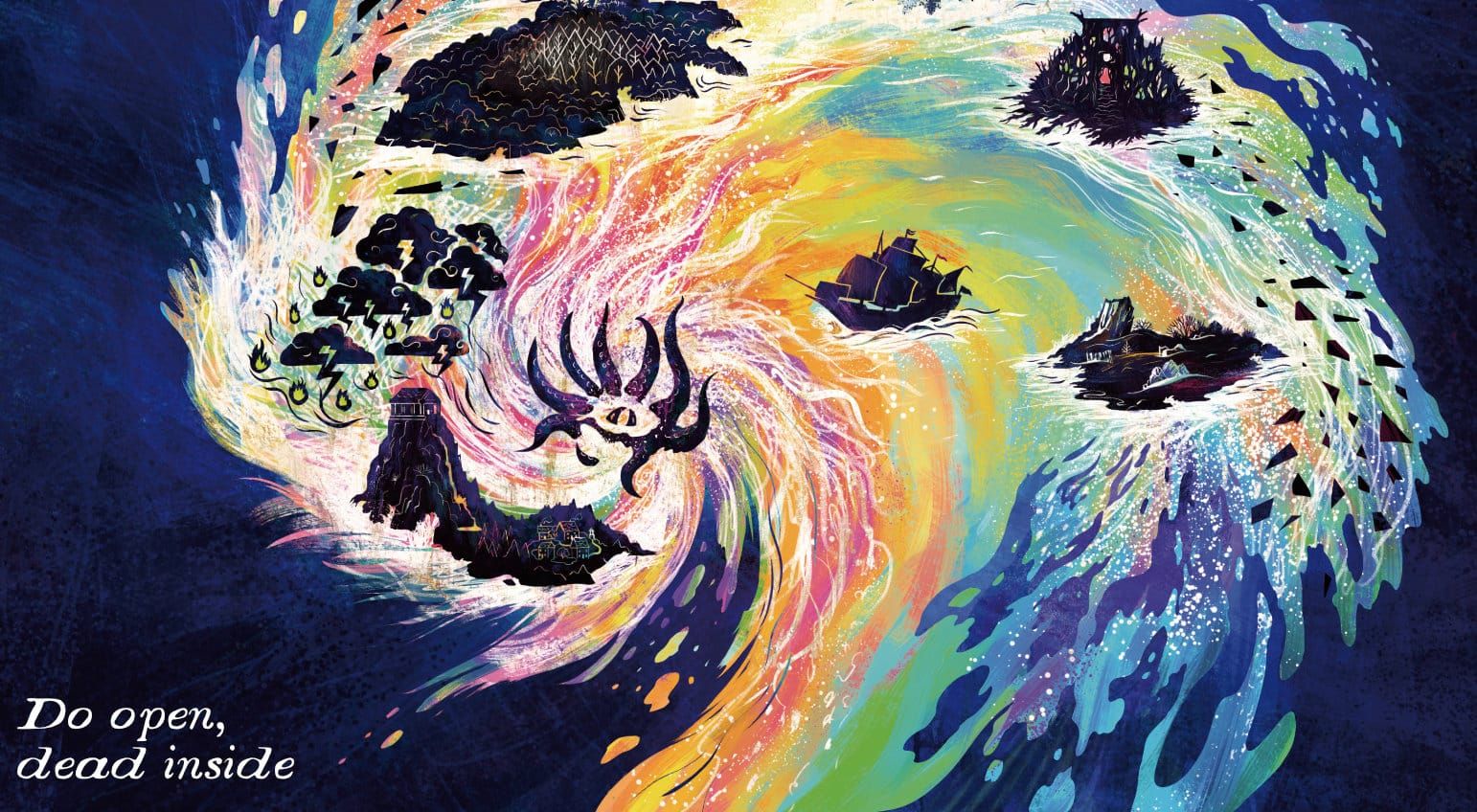
Hey. Before I hand over to Grant “Yes, That One” Howitt to talk about his game… this is an article about Hollows, our game of wretched suffering and resilience (and Weapons powered by toxic masculinity. And big monsters.) in a grim Victoriana setting. If you don’t know what Hollows is, you can read about it here; if you do, you can join our game jam on itch here. - Producer Chant
Hollows are ghost stories.
First things first: every Hollow is built out of a dead person’s worst day writ large. Malignancies – the cosmic carrion-eaters that peck at the pockmarked psyche of the Isles, summoned into being by sources unknown – attach themselves to the most brutal and brutalised members of society and work their wicked magic. Eventually, their target will become the Lord of their own Hollow – unless they’re lucky enough to die before the badness takes proper root, or maybe even process their trauma in a healthy way and reject the interloper entirely (haha. Good one. - Producer Chant) – and their torment will transform them into something great and powerful.
The Grand Malignancies are Hunger, Fear, Fury, Dominion, Grief and Pride, none of which are particularly bad in sensible amounts, but when they’re supercharged by the death throes of a great empire collapsing upon itself, they can twist sufferers into Silent Hill-style otherworlds. Or maybe Jacob’s Ladder-style otherworlds, because they’re more bespoke? We haven’t named any of the lesser ones but we like to keep our options open for any future cash-in opportunities here at Rowan, Rook and Decard, so keep an eye out.
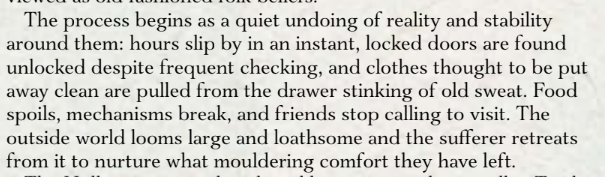
I’ll be blunt; Hollows are a not particularly obscure metaphor for depression, and that’s doubly apparent when we get into how they’re made:
I’ve dealt with my own black dog (as my mother calls the ailment) for many, many years now, ever since I was quite young, and I know how wildly depersonalising it can be to be brung low by it; I used to think of myself as loose change of a boy, barely real at all, like I was strung together with split pins at my joints. Once I was through the worst I even wrote a game about it – not Hollows, which is tangentially about being Very Sad All The Time, but FETCH, a game which if you play it rules-as-written causes RSI.
(I’m better now, thanks to the kind attentions of a very gentle therapist called Richard and many, many hours of desperately trying to be okay. Hollows is in part a product of that betterness, an ode to togetherness and mutual support through the medium of granting other characters bonus actions out of sequence.)
Forgive me: I’m getting distracted talking about Feelings. The Hollowing process continues, the sufferer gets sick and goes mad – even more mad I suppose – and there’s some light inexplicable phenomena and, then, they die and their torment is transformed into the aforementioned otherworld. Every Hollow is the grave of its Lord.
This is how Hollows get the final coda of every player character’s life – although they’re barred from dying by mysterious forces, eventually the Malignancies will catch up with them. Hunters each carry the seed of a Hollow within them, and try as they might, odds are it’ll get the better of them and turn them into a nightmare psychodungeon that their comrades will need to invade and destroy.
Put These Bones To Rest
I like to think of ghost stories as investigations. Ghosts - in the popular imagination - are people who died either with some business unfinished or in the midst of a great passion, and as such their soul is mangled enough to get stuck en route to whatever ultimate peace awaits them and instead malingers around the edges of reality going woOooOoO at odd hours of the night.
To get rid of a ghost, you can’t just hit it. You can maybe exorcise it, but that’s a bit one-size-fits all and honestly I don’t care for it – exorcism is for demons. Ghosts are outside of the Almighty’s jurisdiction – a rounding error, and honestly a little comforting to think of. Imagine caring about something so much you couldn’t even die properly – doesn’t that sound human? Doesn’t that seem like something to aim for? Doesn’t it seem like a kindness, almost, to hang back from the void because you decided there was more to do?
(Although: this implies that it’s not awful for the ghost to be there, and honestly in many of the stories they do seem rather upset, so maybe I’m looking on this in too kind a light.)
No: to remove a ghost, you have to understand it. You sever it from whatever obsession it has, or you finish its business, but you can’t use a generic solution for a personal problem. “Solving” a ghost involves research, empathy, and some creative interpretation of spooky goings-on.
So when we read a ghost story (at least one where the scheme is to stop the ghost existing) we follow the characters through the life of the unfortunate haunter; we see their upbringing, witness the terrible things that happened to them, and see how twisted and dark they became. Often they act out a particular event over and over, unable to move past it, and that’s where Hollows picks up the concept and runs with it.
In The Beginning
In Hollows, you’re putting an unquiet spirit to rest, but you are just hitting it. (Or: blowing it up, or emptying a clip into its back, or beaning it in the noggin with a high-powered rifle round.) The most crucial part about Hollows is that it’s a game about fighting very big and difficult monsters, so we wanted combat to be at the forefront of the experience.
Throughout the development process, the experience of sealing (clearing? Pacifying? Destroying?) a Hollow has changed a little. When the game was called THE SWAMP HAINTS OF SUMPSUCKLE HOLLER*, it was much more investigative and much less illustrative of the Lord. Magic gathered around wrong 'uns and went off, poisoned the world around them, and caused Hollows. Vassals – the subsidiary Entities beneath the Lord – were often corrupted wildlife, and our first ever playtest fight was against A Big Snake. Other baddies include A Big Crocodile and A Big Wolf. The area surrounding them wasn’t a pocket dimension trapping them in place; it was stagnant water, clouds of flies, thickets of bramble and folks too sick or broke to get away before the rot set in. Hunters had to get in there and kill 'em.
(I quite like the Swamp Haints pitch. There’s something quite desperate, mundane and grounded about it. There’s no grand battle for the spiritual sanctity of the nation; it’s just that sometimes arcane energy backs up and curdles like old milk. It feels like the sort of game where you’re counting your bullets, running away from rabid dogs, stumbling gut-shot through a mangrove trying not to die, maybe even drowning someone in a stinking lake. Quite different from the “superheroes with depression and a gun that hates them” vibe that we ended up with in the final version.)
You can see some of this DNA in Morningmire, Chris’s scenario published in the back of the corebook. Morningmire has corrupted wildlife in the form of the Tick-Covered Stag and the Nine-Lives Cat, both of which were the result of my influence as we rewrote the setting to make it more supernatural and more on-the-nose in terms of displaying the Lord’s fears, frustrations and madnesses. The ticks represent Leah’s harrowing depression and lethargy; the cat is a bit more straightforward, because she didn’t like the cat when she was alive and now it’s taken up permanent residence in one corner of her mind out of spite.
One Of Them Japanimations
I’m reminded of the Witches’ domains in Puella Magi Madoka Magicka, an anime I definitely need to get around to finishing one of these days (it’s been a decade, so you’d think I’d have found the time by now, but here we are). It’s a magical girl anime, but it’s a postmodern reinterpretation of the genre, so it’s very dark and grim and dehumanising – the Witches are the natural (unnatural? I really ought to finish it) enemies of the Magical Girls, and they infest the real world and subvert it to their own internal reality. The animators represented this by switching art styles away from a traditional anime look to something completely different when the characters enter a Witches’ domain – the first one is a hot nightmare cut-and-paste collage of butterflies and tin soldiers.
We do the same thing with Hollows, in as much as every Hollow we've published so far uses a different artist, so we can underline the fact that they’re all unique.
I’m very glad we ended up with this setup; it means we can work with a lot of interesting people, including some who we would have no hope in hell of hiring for a full book – the more established artists become and the better-connected they are, the more they move out of our price range given that we’re a scrappy wee studio without much in the way of spare cash – and, what’s more, we can encourage them to take some bigger swings with their style, because it only has to hold out for about sixteen pages total.
Allegorical Geography
Hollows, then, don’t follow the laws of space and time as we understand them, because they don’t have to.
We use the phrase “allegorical geography” to describe the metaphorical, portrait-of-a-life stuff that turns up inside a Hollow. How the Hollow operates, how its laws of physics work and its spaces relate to each other, and what it all looks like – and to what extent it becomes unreal and outlandish – comes down to the Malignancy, the Lord, and the author of the adventure.
To ensure that the themes stay prevalent throughout the scenario, each location within has a Root: a simple idea that informs the portrayal of the Lord’s malaise throughout the area. Each Root is a grounded, real-world thing without much in the way of frills; it’s the writer’s job (and the GM’s, too) to weave that obsession, doubt or grudge into the fantastical without necessarily stating it outright.
Let’s say that the Root of an area is something like:
- The Lord hated it when people looked down on her due to the circumstances of her birth
Then the location might be, depending on the rest of the Hollow and the Malignancy at play:
- A gallery of mocking statues quite literally looking down at the Hunters
- A stinking pit where meat-puppet versions of enemies from their life before cower before their might
- A towering family tree in the form of an actual tree, with rotten fruit growing on the branches
- A huge barbed ladder representing an unsubtle metaphor for social climbing
- The lair of a Vassal Entity: the Lord’s husband, a commoner whom she married for love, and whom she grew to hate
- A court of captive “nobles” who desperately caper and cavort for the Lord’s approval
We have a guideline in the core book where we encourage GMs making their own Hollows to be as on-the-nose as possible. There’s no room for subtlety here: you’re stringing together boss fights and exploring them in an unscripted story acted out by keen amateurs.
In fact, subtlety is the last thing you want here.
I’m reminded of a piece of advice given to me by Greg Burridge when (believe it or not) I was training to be a luchador in a sweaty Bethnal Green gym back in the early 2010’s. When you’re a small-time wrestler, you don’t have the luxury of extended promos or behind-the-scenes footage to establish your character. Chances are, when you walk out in front of the (drunk) Friday night crowd, they haven’t a clue who you are and you’ve got five seconds to:
- Show them your gimmick
- Do something entertaining
- Make them care (positively or negatively) about you
Otherwise, you’ve lost them. And I feel like roleplaying games, and Hollows especially, are kind of the same thing. Don’t mess about with it. Don’t be coy. Don’t withhold information. Give the players lots and then give them more.
You want to show a Lord’s descent into lunacy? No longer are you limited by maddened scrawls in missives or neighbours talking about how strange they’ve been lately. No longer do your players require a working knowledge of forensic investigation to piece together the story. No longer are you limited to sort of half-heartedly describing a diary.
Now you can put the worst day of their life on repeat and give the Hunters a front-row seat! You can inflate and twist their obsessions into grotesque parodies of themselves! You can turn their enemies (or friends) into monsters and have them bash the tar out of the player characters! You can cut straight to the bone of what’s wrong with them, then find another more audacious and violent way to say it, and do it again.
I love how blunt and garish the storytelling is in Hollows. And you can do it all sneaky and clever-like, if you’d like; it still works fine. But I encourage you to give into your grimdark impulses and descend into this camp over-the-top phantasmagoria with me, and see if your players don’t enjoy it too.
*For more on this and other related bits of Hollows ephemera, see our director's commentary podcast series, available here and under "Rowan, Rook and Decard" wherever you get your podcasts.