
Jay Dragon & Minærva McJanda talk storytelling game design: full interview
We sat down with two masters of storytelling game design to discuss how to give your players agency, what makes meaning emerge through play, and much (much) more...
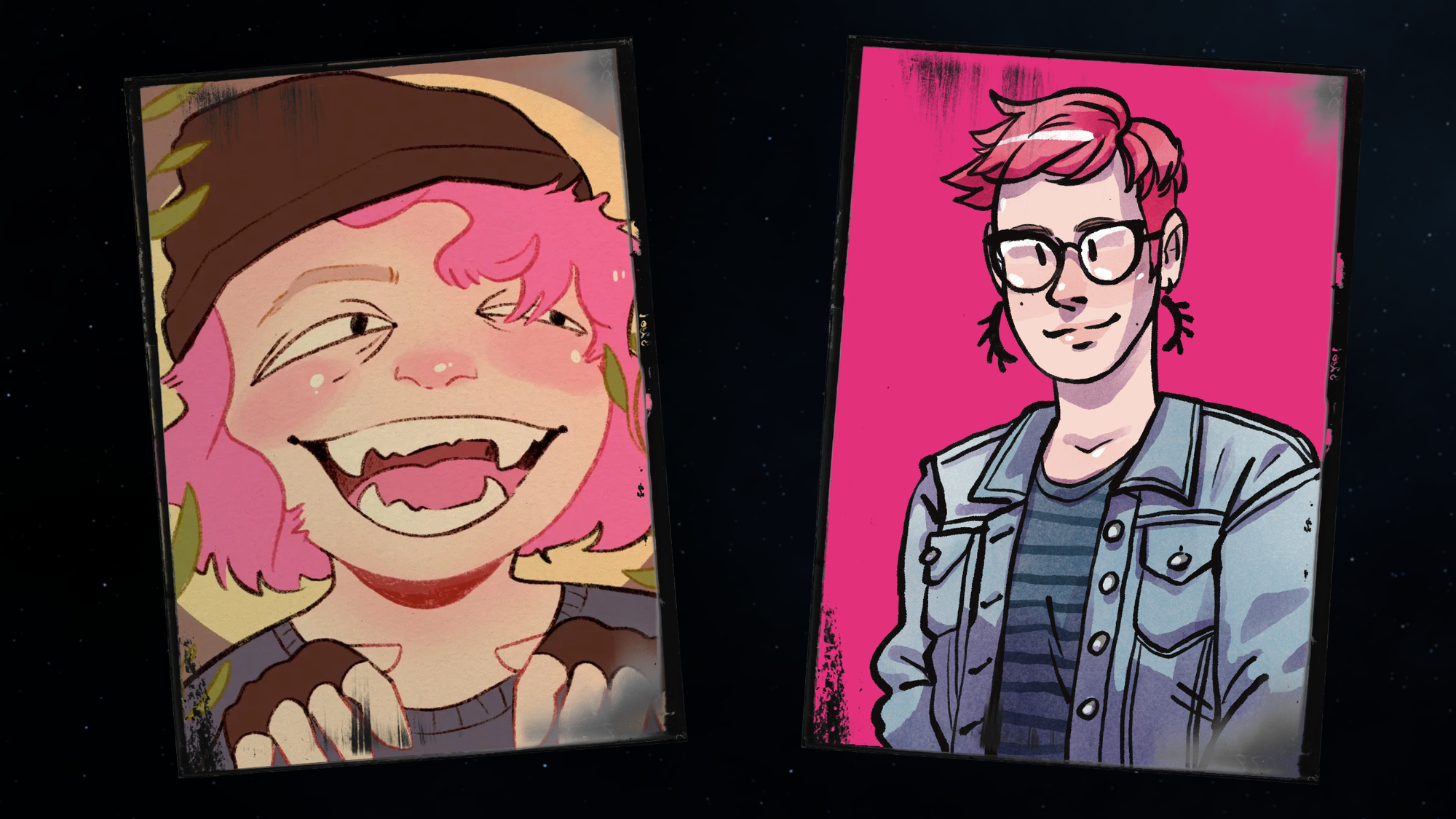
We sat down with Seven-Part Pact designer Jay Dragon and Children of Time RPG designer Minærva McJanda for what was meant to be a short interview about designing storytelling games, and ended up more than an hour long. You can click here to read key insights from the discussion, or read on for the whole thing below.
RRD: Tell us a little bit about Seven-Part Pact, Jay, and what’s fun and exciting about it that we might not already know.
Jay: Seven-Part Pact is an elaborate, ornate wizard game. You play as seven powerful men; you each have your own domain, the area you govern over. You are each also a GM of a different aspect of that. The rules trap you in masculinity and responsibility, and magic is your tool for breaking out of that. A lot of the game is focused on the way that plays out. I've been describing it as – it's got that, like, Game of Thrones quality, where you have a bunch of different plotlines, and they each advance forward in their own way, and then they entangle with each other, and they ripple out from each other. It's a game that's about going in very deep. And it's also a game about interpreting the text and having wizard arguments and all that stuff.
RRD: And Minærva, tell us a bit about Children of Time.
Minærva: So Children of Time, based on a series by Adrian Tchaikovsky, who I first met when he sacrificed me to his wasp god in a LARP. It’s a game about societies developing over interstellar distances and generational timescales. There was an interstellar civilisation of humanity that got to the point where they were reshaping new paradise worlds, and then they all fell apart. And those worlds that they've seeded grow strange new life in their absence, and survivors of the apocalypse on Earth hear about these paradise worlds and try to get to them because they're far better than the old poisoned Earth. And it's about these two societies, the humans on the ark ship desperately trying to cling onto life and get to a new home, and the creatures on those orphaned worlds evolving and finding a new sense of themselves.
So a lot of it is about comparing these two, right? Saying: these people developed in this way under these contexts. What are their counterparts going to do? A large part of it is zooming in and zooming out.
RRD: The reason I wanted to talk with the two of you is because these are – in a lot of ways, these are really distinct and different games, right? On the one hand, you have Seven-Part Pact, where you have a character that you are stuck in and stuck with, whether you want to be or not. And in Children of Time, you have the ability to take on and leave off characters in a way that you don't in almost any other RPG. You're playing, in quite different ways, with that sense of characterisation. But there's something that feels quite consonant between the two around how you're thinking about narrative control and giving that narrative control to players, in a way that a lot of traditional TTRPGs and just a lot of traditional tabletop and live-action games in general don't do. So I'm interested in getting at how you both think about narrative control – like, what is it that you're giving to the players, and what is the role of a player in these games.
Jay: I think I've been really board game-pilled lately. I've been really enjoying board games. And a thing that I really appreciate about them is that there is a broad culture of, like, let's all show up, understand the rules to the best of our ability, and let's, like, play together, right? I think it would be kind of a weird experience if you showed up to play board games at a friend's house, and a friend was like, “Okay, so I'm not playing the board game. I'm watching you all play the board game, and I'm, like, going to make choices about it for you, but, like, I'm not playing it with you,” right? First off, it would feel kind of not true. It's like, well, you are playing the board game, and you're doing a weird thing with it. I think there's a lot of struggle in RPG cultures of, like, “Oh, the players don't read the rules.” And I think a lot of that comes from, well, it's really easy to not read the rules if there's a dedicated rules knower who's separate from the game.
Like, that's kinda weird. And I think, to me, the idea of giving players agency over the setting almost feels like the default no-brainer, because that's just where I'm coming from, coming from a world of collaborative storytelling and online role-play and board games. That's kind of how those things work, so then RPGs often, to me, feel like the odd one out. I think that as we see a lot of new games inspired more by online role-play and inspired by the collaborative storytelling that a lot of us have now, at this point, grown up with – I was doing online roleplay before I was a person – when I was, like, 8, I was on the Spore Forum pretending to be a little creature. It seems like both these games really kind of have learned from that style of play, that culture of play. Minærva, does that feel true to you?
Minærva: Yeah, absolutely. I come from the position where the foundation is playing pretend, right? The core unit of role-playing for me is describing a thing and then asking someone else, “What do you think about that? What do you reckon happens next?” These ideas – they rhyme, they're consonant. Both of them are about building this thing together. When you're playing a board game with friends, you're buying into this shared concept that you're developing and reinforcing together. When you're playing pretend with friends, doing free-form role-playing with friends, you are building this shared thing together. And that's the juice of it for me. Like, that's why I play games. I mean, most everyone I play RPGs with these days are people who are pretty skilled GMs themselves. And I think that there's a real joy in that, just, like, being free and flexible and saying, tossing over to someone, like, “Hey, there's a guy in the corner over here. What do you reckon he looks like?” Or, like, “There's bad weather moving in. What kind of thing do you think it is?” And that sort of stuff.
So even from the jump, Children of Time, when I was conceptualising it, the idea of a GM just didn't fit. I was breaking down what I thought the GM should be doing in it. I had the realisation this could be GM-less and was putting in ideas of making that optional. And the team suggested, “No, just let's make that the default. It's clearly the better fit.” There was some fear to that because people look at GM-less games and think, “That's weird.” But I think they're so much easier to get into for a lot of people than a traditional GM role, because so many of your traditional RPGs don't actually spell out what a GM is meant to be doing. Whereas I was writing down Children of Time stuff, and I'm thinking, “Okay, so someone's going to be needing to play main characters. Someone's going to be needing to play background characters. Someone's going to need to play the world, the plot arcs, the rules knower. Someone's probably going to need to be facilitating sessions and, like, I don't know, arranging snacks or whatever.” And it's way better to have that consensual and communal.
Jay: Yeah, I completely agree. I had a similar process with Seven-Part Pact. My little joke in Seven-Part Pact is there's seven wizards, and each of them correlates with a style or responsibility set of GMing, right? You have the narrative railroad GM who's like, “Okay, I know what your secret plot is, and I'm trying to get you to do it.” You've got the antagonist GM who has schemes. You've got the rules knower, big structure builder GM. And you've got the GM who's just like, “I'm just keeping track of where the boats are,” right? Strategy GM. And then you've got a GM who's like, “I don't touch anything unless someone's about to die. Then I'll step up.” All these different kind of, like, styles of GMing. And what's really struck me with Seven-Part Pact is, during playtesting, people will engage with it as a player, and they'll feel nervous. Then the more they engage with it, the more they use their GM muscles, the more it starts to click, until you'll have games where people are prepping encounters for each other. They'll be going into it. They'll be like, “I've built a dungeon.” And then it's like, “Oh, let's all go in the dungeon, and I built the dungeon, but, like, you could have built the dungeon,” right? Like, any of us could have. I just was the one who did.
There's some GM-less games that say, like, “Hey, let's all approach this as players. No one should be responsible for knowing the rules. No one should be responsible for the world, right? Let's all just kind of try to be players.” And then there's approaches that's like, “Well, no, let's all take it on in the same level of fervor and intensity that you can bring to a campaign. Let's bring that energy to it.” And that shifts gears completely.
Minærva: Absolutely. I've been doing a lot of, mostly free-form live text role-playing recently, your big Over/Under style games. I see a lot of what you're talking about there, where people will be having a scene just through free-form text role-play, and then someone's like, “Oh, it looks like this is going to be a fight. How about I step back and GM it for you?” Or, “Oh, you've described that your character's been injured. Do you want to roll some dice to see how well I can treat you?"
It's all so consensual, you know? It's in the moment making the decision: would this make a good story if we added rules to this? Vincent Baker had a philosophy around playing pretend and just saying, “I do this,” and someone's saying, “What happens?” That's the flow of gaming. Everything you add has to be on top of that. And I think specifically how he stated it is, the job of the rules is to create outcomes that no one at the table was gunning for. Because if it's something that someone at the table would have just said naturally, the rules serve no point.
Jay: Yeah. I always love that framing. There's the idea of – what is a game? A game is obstacles in pursuit of an arbitrary goal. Rules are intended inefficiencies, right? The way Sitand Yoyan talks about it is, he loves to go rock climbing, and it's like, “Well, why doesn't he just simply take a helicopter up to the top of the mountain?” If his goal is to rock climb, why does he simply not drive his car up to the top? Well, because you want to rock climb. You're there to do the thing that's inefficient.
If it was the best way to get somewhere, it wouldn't be a game. It's only a game because it's the less effective way. The most effective thing we could do is just be like, “And then this happens. Ah, and then this happens. And then this,” right? We just, like, write a damn book, right? But we want something to get in the way. And we want something to wrinkle us and to be like, “I wanted things to go this way, and then they didn't. They zigged instead of zagging. And now, suddenly, I've got to account for that.” And the surprise is kind of the mechanism of what makes the game the game.
Minærva: Yeah. Paul Czege stated this as, “It's not satisfying to resolve a problem you yourself introduced."
Jay: This was a pain throughout Seven-Part Pact design. I was running headfirst into that exact problem. Because that's the problem that GM-less games face, right? Is that. If you're not careful, it's really easy to be in a place where you're like, “Oh, well, wouldn't it be cool if there were some evil wasps? I guess I'll go and kill the evil wasps.” And now there are no more evil wasps. Great.
And so I had to constantly be like, “Okay, so when you are the Necromancer and you're fighting the foes of death, this is the person who plays the foes of death who is different from you. And then when that person is dealing with the foes of death, someone else–” making sure everything has fail-safes, and you're always handing off your stuff to other people. The game feels alive when you put something out into the sort of shared space, and it comes back different, right?
Minærva: It feels alive. And that's one of the great things I noticed when playing Seven-Part Pact is all these things leave your view, and then they come back different. And that's a large part of the world in Children of Time and how I’m trying to design it. You pick things up and put things down. You return them to the box to be brought out later by someone else. You hold these characters loosely so that someone else can pick them up and show how they've changed in the interim. We don't have you playing the Necromancer or the Mariner or whatever. You're picking up a play stance instead: the narrator, doom, viewpoint character, that kind of thing. That's very intentional.
If you're playing a character, if you've got a guy in the scene, you've got the viewpoint character stance, and that tells you questions you can push for, fallout you can apply to yourself if you want, that sort of thing. But someone else is playing the doom. Someone else is playing what's going to go wrong. Someone's playing the historian who's going to talk about how you're remembered, all that sort of stuff. And it just whirls and builds and layers. And I just love it so much.
RRD: I want to ask you both about the narrative joy of being a dickhead to your fellow players. I mean, Minærva just mentioned the doom play stance in Children of Time. And I know, Jay, that for some of the wizards in Seven-Part Pact this is more true than others. One of the things that's commonly kind of talked about in the GM role is this a very trad idea of the GM as an omniscient but slightly evil narrator, who has this power over the table and kind of delights in being cruel, and being a little bit mean. In all sorts of different storytelling games, you have this experience where the players can bite back a little bit or where there is a troubling of that very traditional kind of power balance. And for both of these games, that power balance explodes completely, and everyone gets to take on being a bit of a dick. How do you get over the hump of not wanting to be a dick to their fellow players in service of an interesting story?
Jay: I ran into that a lot during playtesting. It's very common to encounter people who are like, “Oh, I'm so scared to make anyone feel bad.” A thing I've been trying to think about a lot with games is: winning and losing – they're not actually words that mean anything. They're social valences that happen in the game, right? If I congratulate you on winning, it's a speech act that I'm doing to you, that I'm improving your esteem. Or if I apologise to you for you losing, I'm degrading your esteem. But those don't mean anything outside of it, right? And people associate making problems for other people with making them lose. So therefore you are performing a speech act to them outside of the game that makes them feel a little bit bad. To change that, you’ve got to teach people: games are about balancing on a tightrope. And when you're being a dick, you're maintaining the tightrope. You don't want to, like, whip it around and fuck with someone too much, but you have to maintain the stress of the tightrope, or else they just aren't able to tightrope walk, right? The magic trick is creating that strain. And teaching people that that's okay means building structures. It's much easier for people to be a dick when you give them a list of what specifically they are allowed to do to other players. It's one thing if I just tell you, “Hey, you can be a dick.” That's kind of scary. But if I tell you, “You are allowed to bite me and stab me and, and grab my hair and fuck with me in these ways, and you're not allowed to kill me,” then people are like, “Oh, cool. That feels much easier because I can just choose from my menu, and I know what not to do.”
The biggest thing is shifting the mindset towards the idea that making problems for people is a gift. The game is at its most boring when no one makes any problems for anyone. The game is at its most fun with problems. The more problems are made, the more the game takes on a life of its own, the more things begin to boil over. You will know if you go too far, right? I've never seen in a playtest someone create a problem that genuinely made the game unplayable for anyone. I've had a player one time rip a hole into death and cause the largest city in the setting to collapse into death and blow up three different people's domains. It caused my character to have to flee the country, and my undead father beat me in a wizard duel and killed me. And, like, cool, right? Cool. That was awesome. I loved that, right? That's like a level of a problem that is campaign-ending in a Dungeons & Dragons campaign. And it's cool to just be like, “That was neat. Let's keep going."
Minærva: Most of the games I play these days, players are champing at the bit to have bad things happen to them because it's fun. It's maybe a weird analogy, right? But if we're talking about a situation where someone is in a position of, like, “I am here to hurt this person who has come here consensually,” you know? There's already lots of, uh, social stuff around that. And it's the person who's there to be hurt who has the power. The person who's doing the hurting is the service provider. You can talk about that in all sorts of different contexts, but the thing is that you are giving people a gift, as Jay said, when you cause problems. The main thing is giving them a good sense of what problems will lead to gameplay. Which problems feel like a “no” and which are “no but”. The biggest thing that you need to work out for these games isn't, “How do I hurt people in a way that is going to be fun for them,” but more, “When do you end a scene?” When have you caused enough problems and you can move onwards? I would like groups to understand it's good to cut.
Jay: Yeah. Jason Morningstar actually wrote a really good article about that that I've been thinking about because I've been having the same challenge. I found that it's easy for things to start to drag out. It's about, basically, editing – being willing to be like, “Hey, sounds like we're done.” A thing I've been thinking about implementing that my friend Isabel, author of Girl Frame suggested is – it's really hard to just tell people to do things, but it's really easy to give them a set of things they can do, and that makes them feel better about doing those things.
So for ending scenes, a thing that I'm interested in trying out is instead of just saying, “Oh, you can end a scene whenever you want to,” say, “Here is a set of questions you can ask in order to end a scene.” To be like, “It sounds like we're done here. Is there anything else we want to say?” Or, to ask, “What do we linger on as we end the scene?” “What catches our eye as we end the scene?” “What is revealed to us when we end the scene?” Giving someone a question to throw in at the end to wrap it up, is a valuable tool I've been thinking a lot about.
RRD: Yeah. There's almost a ritual element to that, right? Social interaction in general often has those rituals and those components. Conversations don't peter out. The word “goodbye” and the rituals around taking leave of somebody after the end of a conversation – those exist to allow us to tie a thing into a bow and complete it and then move on to the next bit. So putting those in in the play experience seems like a sensible way of getting around that, in a way that allows, again, for that mutual collaboration rather than individual control. So if you've got a GM, they say when the scene's done, right? And that misses the essential shared nature of what is happening in this style of conversation.
Jay: Yeah.
RRD: There was something I wanted to ask about emergence. My ancient history here is in live theatrical games, and we did a lot of work there on how each game experience is an emergent property of the system. So, you give people rules, and then they will mostly ignore those rules, but sometimes in quite predictable ways.
To give you an example, we ran a game which was essentially a zombie game. We gave zombies a speed at which they moved and told them they responded only to certain kinds of stimuli, like noise or movement. And those rules were lies. But they were useful lies because they gave people the benchline to fuck with. We knew zombies would always go faster because people get excited, and people bend the rules, and they want a bit of the story. And the thing that they can do that's exciting is chase people. So it was all about giving people acceptable parameters, knowing that they would cheat.
Jay, you've talked a bunch about the idea of cheating rules and rules that are designed to be ignored. And I'm interested in where that lives in this world where there isn't a GM you're cheating against. It's the system that's doing this.
Jay: I think the art of games is when they're more than the sum of their parts. I feel like the thing that all the game designers are chasing after is – I think about it as showing instead of telling. In Persuasion by Xoe Allred there's three qualities that your Regency Era suitors are looking for in their lovers – you can be looking for hearts, diamonds, or crowns. Fame, wealth, or romanticism, attractiveness, charm. Charm is the least likely thing for you to be looking for. People have charm, and charm has powerful cards, but often you do need a lover who has more fame than charm, right? Ultimately. That's what's more important to you. You want to win with a husband. But you can manipulate your lover, and there's all these things that come out of that, all these implications. Then you realise you're sitting there thinking, “I know this guy is charming, but I need him to be better with money before I can date him."
Then you’re like, oh. The game is doing the thing to me. That's the art of games: when the experience can get you into that space without needing to say so. And that's so hard! You can't do that with everything, or else you'll just reinvent the universe from base principles. You have to choose a certain level of your telling people things. With Seven-Part Pact in particular, the way I approach it is that the rules are, in-universe, the way the wizards would conceptualise the world. Each wizard's domain board game is a map of the wizard's viewpoint of reality. In the same way that I have a mental map in my head of, like, my house and my grocery store and my office and my job and the RPG ecosystem, like, these are maps in my head.
Wizards have their map, and it's like, “This is how I think of the world,” right? “This is my alpha and omega. Your map over there is different than mine, and it doesn't make any sense to me.” And the rules that I'm bound by are the rules that I would sensibly be bound by, right? The goal was as much as possible that if a wizard was asked to describe their worldview, this is how they would do it. That means that the thing you're rebelling against when you rebel against the rules isn't these arbitrary rules that are kind of imposed from beyond. It's more like, “I'm rebelling against the mindset that I have been taught in character. And every time I choose to work against a rule, it is me rejecting the firmament of the reality I believe in.” By making it in universe, It means breaking it feels like the act of breaking a rule is a character choice. You're talking about your character, and it changes what you're saying in a way that's different than, if you were like, “Yeah, I know that I'm supposed to have 12 intelligence in D&D, but I have 18 intelligence.” It's like, “Okay, who are you rebelling against right now?"
RRD: With the D&D example, it becomes about winning again. It's optimising to a stated purpose that is all about winning the situation rather than seeing what happens in the situation.
Minærva: What I love about game design is the ways in which game design is mind control, you know? It's the way it's setting up incentives and costs and ways of approaching problems. One of the things that exists in Children of Time is, whenever you go to the dice, you have to decide, “How is my character approaching this?” Are they gambling? Are they being cautious? Are they trying to protect themselves rather than focussing on winning? All of those things flow from their social context and the particular situation and flow out into the world. That very simple choice keeps happening.
This is a game about culture, where a large part of your character traits and abilities come from the cohort that you're a part of in society, whether that's the leaders of the ship or the farmers on the planet or a secret cult working in the background. And so a large part of the design was working out how to make characters rebel against that cohort they're a part of.
Part of that is the standard carrot incentives – giving characters beats to hit that are going against the cohort and pushing their own plot a lot of the time. But it's also things like saying, “All right, the tools you have are these. And how do you feel about them? How do you feel about what they let you do?” Because if you think that the tools you have are bad, if you think they're not bringing the outcomes that your character wants, well, they can shift. They can change. They can move to a different cohort. They can move to a different role. They can redefine themselves in all sorts of ways. And redefinition is the joy of it. It's the juice, you know?
I think for me, stories are about moments of change. This is my role-playing style, you know. I don't look for moments of triumph, or moments of overcoming challenge, so much. I look for moments of transformation. That's the narrative beat of the story: you go from transition to transition to transition. It's like a flick book – each time you flick, it's changed, and that makes the animation the story. You're not in control of when those transitions happen necessarily, but you can shape them. You can guide them. That helps with emergence. That helps each character feel alive.
Jay: I like to joke that game design is mind control too, but only in the sense that mind control is a made-up thing. That doesn't actually work, right – it's like hypnosis is a thing you allow to be done to yourself. And then you're like, “Wow, I can't believe I've been hypnotised.” Properly, you have brought yourself into a hypnotic state with the assistance of someone else. I think similarly, game design is a willingness to go somewhere implausible that you are doing yourself. The flexibility of that is really beautiful. You have to be careful because too much flexibility shatters the illusion. But it's the illusion that people are kind of playing with.
Minærva: This is why I make these toolbox games, you know? These ones that are very explicit about, “Here is this tool. Here's how it's used.” Trying to give you the tools to weave that in so it's not game-breakingly disruptive in the process. I think of game design a lot like writing sheet music, and it’s the play group that is the orchestra. It's up to them what spin they put on it. Or it's like scriptwriting, and a play group is the theatre.
RRD: This is where I get back to that principle of emergence. What comes out of the game design is not performance. It's more improvisational. Maybe I think game design is more like trying to construct the eight-note octave scale, and the time signatures that are achievable with human rhythm. And then maybe constructing some instruments and then trying to get people to mash those things together to create jazz. I recognise it's a much less elegant metaphor, but it's about the construction of the system that sits underneath the thing that becomes the performance. You can structure and you can layer on top of that these very rigid systems, your Baroque musical rules around precisely what goes where and how that all kind of fits together, or you can be very free-form with it, but it's the system and the structure that underlies it that is what gives rise to these really different experiences.
Minærva: I mean, like, to say something entirely ridiculous, architecture is game design. Anything that shapes how people flow through an area – shaping flows is game design, you know? Creating channels of less resistance and places of friction is game design. Both games, in different ways, are both complex ways of telling a story, essentially. If what you are used to in games is that kind of win-loss idea – I don't like saying more traditional because I think storytelling and storytelling games have been around for a hell of a lot longer than storytelling games where you can win – but there is a kind of 50, 60-year history at this point of the kind of this genre being squeezed into the win-loss, like, picture.
Jay: Which is still the struggle board games have. Xoe Allred has another game, Conviction, which is a two-player card game where you're in a relationship. One of you is an idealist. The other one is pragmatic. And you are having an argument. There are three ways the game can go. According to the cards, the game can end in compromise, in domination, where one person wins out over the other one, or in breaking up. You can just choose to end the relationship. None of those are win or loss conditions. None of those are better or worse than any other outcome. They're just three different ways the game can go. And there's a great line in the rulebook which says, “If you think you have found an abusive strategy, you are correct.”
There are strategies in this game that allow you to manipulate, gaslight, and – not win, but to claim domination if that's the strategy you're going for, if your goal is just to break up as quickly as possible.
One of my favorite board games that I've played in recent years is Oath by Leder Games – now by Buried Giant Games. It's a big map, where you’re moving armies around, exploring a world and getting resources and moving your character and competing to be the regent and all that sort of thing. But there isn't really a winner. What you end up with at the end of each game is who will play the regent next time, and how that particular era has changed the world. The card deck of people and places you draw from is different every time because of the choices you've made, but not in a destructive way.
Minærva: So there's a thing in Children of Time where characters don't die per se. I never say that a character is dead. I say they're lost. And then you put them away. Because it's so interesting when something that everyone thought was lost comes back. That's such a beat.
Jay: Yeah. I love that. And similarly, in Seven-Part Pact, because Death is one of the realms, there was a concern with characters who die, that get transplanted over into Death. There's a good chance that in Death, they will come back up again. The gates of death become kind of a graveyard for the plot of the game. Like a memorial house full of your dead – your problems that you have dumped in there. I think there's something cool about that. A lot of what makes a game come to life is the feeling of inventing these little plotlines. Introducing new characters, tossing in new little guys. It ends up with them all over the place, and you end up holding on to some of them. And then next time you get a chance to maybe resurface one, and then suddenly you’re like, “Oh my God, I forgot about that little guy.” Like, “Oh, he's back,” right?
Seven-Part Pact sometimes during a playtest will just end up with a family drama that has nothing to do with any of the wizards. We get to see, maybe, two of their sons – one of them's a researcher at the academy, and the other one is a noble in the court of the king. And then the mom of course is manipulating the queen, and then suddenly she has a destiny. It's like all of a sudden, these characters all fall into place with each other. And it's completely outside of us. It almost feels like it's like the game having a little B-plot of its own that none of us get a window into.
Minærva: Yeah, Have you ever tried to think up a band name and they suck?
Jay: Yes, absolutely.
Minærva: And that's because all band names suck to begin with. They build up meaning through resonance, you know? Every time you hear it and you associate it with a new thing and add a layer, it builds more. So that's the goal, to create things that keep looping around and coming back and building up and layering up and developing this meaning so that when they come back up, everyone's like, “Oh, shit. It's this person.” And that's not because, like, you described them as really cool in their six-page backstory. It's because they've seen them and seen how they've altered and changed over time, and they're back again. And that's wild.
Jay: Absolutely. And the joy of a character who's been gone and then you find out what they've been up to is always such a cool feeling. It's like, “What have you been doing while we haven't seen you?” In Jonathan Strange and Mr. Norell, by Suzanne Clarke, big inspiration for Seven-Part Pact, there's the women in the book are just as important as the men. However, the narrator of the book does not understand that. The narrator is just talking about what the men are doing. And you're getting glimpses into what the women are up to. And you're like, “Oh, fuck. This seems really plot critical.”
The men are completely oblivious to it. And even the women, like, a woman will go up to them and be like, “I need your help.” And they'll be like, “Ugh, the hysterics of women,” you know? You're like, “Wait. This is, like, a totally different plot that seems much more important, and we're just dealing with stupid things while this important thing is happening.” Sometimes in Seven-Part Pact, though, you'll get that beautiful moment of, “Oh, while we weren't looking, the wizard's wife fell in love with a baker and has decided to move out and started a bakery.” Now you have to go and convince her to try and win her back maybe. But you don't know what she's been up to, so you have no idea about her personal life, you know?
Minærva: It's creating life, right? There's this mechanic that I added quite recently to Children of Time where after you've had a big zoomed-in scene where you played out big things with characters, doing adventures, whatever, you zoom out and you look at every other character on the board, and you have a brief beat to see if anyone has ideas for what those characters have done. And if they haven't, you roll.
The things that happen when characters' actions are rolled for are much less good, much more problem-causing than if someone had an idea like, “Yeah. This guy's gonna work in the forest. This guy's gonna work on, like, making friends over here. This guy's gonna rest.” If you let them roll for it, it'll be like, “Oh, this guy got in a fight at a bar. This guy got injured at work, that sort of thing.”
Because, either way, that's cool, right? That means that if there's a character you don't have a strong idea for, you get more details. And if there's a character you do have a strong idea for, you're incentivised to put that into words and have that little beat with them. So either way, your cast grows more, like, developed, and it's great.
Jay: Yeah. It feels a lot like Katamari Damaci. You've got a ball, and you're rolling it around, and you're accumulating meaning. At a certain point, the quantity of meaning is meaningful. The idea that this character has so much meaning to them, even if it's not a clean narrative arc or a satisfying hero's journey. That’s not the point. The point is that you rolled them around enough, and they picked up enough stuff that they've accumulated meaning. And now they're, like, full of meaning. That's what you're doing in RPGs. You're all rolling around this stuff, and you're picking up all this meaning, and then you're delighting in it.
Minærva: Games are self-indulgent things.
Jay: Another game design struggle, right, is when you have these characters on the table that theoretically have a job. People really want to go to do a character's job and not fuck it up. You have to teach them how fun it is to fuck up a character's job, and to have downtime and to start beefs with coworkers and get in fights in a pub and that sort of thing.
RRD: Going back to that point about the accumulation of meaning through play. This is ultimately where we're ending up here – the play experience is ephemeral. It is a thing that happens live that cannot be captured in a meaningful sense. It only emerges in that moment. But the thing that sticks with you afterwards are the narratively satisfying things. It's some of the stories you've told during this conversation, right? It's that narrative grit and gristle turning into something that feels like a real payoff.
I'm wondering – aside from pulling characters back in and trying to give opportunities for things to roll around enough times that meaning accumulates – how do you try and build a system that encourages that narrative satisfaction without a single hand or an authorial voice in the scene?
Minærva: My answer for this would be giving physical embodiment to some of the concepts and ritualising them. I'd like Jay to talk about that – the way Seven-Part Pact handles it is through the board games, right? That's kind of the function of the board games. I've seen a couple people on Reddit and elsewhere be like, “This is just a board game with an RPG tacked on.” And I'm like, “That's very cute that you might think that. That is very different from how I am thinking of it."
RRD: We got that for Hollows as well, so.
Jay: People get confused easily, I say with grace. A lot of the thrill of physical components is that we love it when there's a little object that has meaning. I think about this all the time in regards to Princess Mononoke, where very often, the way characters will express affection for each other through the passing on of objects or information. The way Ashitaka's sister says goodbye to him is by giving him something. She cannot say, “I love you.” She cannot bring herself to say anything more. She just silently gives him something. And there's something about that – once you've got a little object that has some kind of meaning, it just begins to accumulate meaning. So when you can have a little token or a little index card that's got someone's name on it, and it's over there, and you're like, “Oh, it's over there. That's great.” And then someone else picks it up, and they write something on it. And now it, like, physically gains meaning.
So the physical objects kind of enable you to keep track of all these little things and be reminded of things that you've forgotten. One of my favorite little rules in Seven-Part Pact is that you can make treasures with magic. You write it down on a little index card. If you ever physically misplace the card that had the treasure on it, you do lose the treasure. Because that's what happens, right? You're a wizard. You've caught all these treasures. And if you couldn't bother to remember where you put the index card, you do misplace it in the game. Now you've got these little index cards you care a lot about. You wanna keep track of them, remember them. So it kind of builds that wizard mindset.
Minærva: Absolutely. We started in PBTA design, you know, I think similarly.
Jay: I started in LARP, but I did go on to PBTA.
Minærva: Yeah. Okay. We started in LARP and then in TTRPGs. That feeds into my point, honestly, because the LARPs I started in, everything is physicalised. If, say, a sword is special instead of just a regular sword, it had something attached to it, whether that's a ribbon or a little laminated card or a card that you keep on your person that is tied to it. I remember the first festival LARPs I'd go to, you would enter a tent, and it would have a little laminated card hanging up saying, “This is how this tent has been, blessed. This is how you feel while inside it.” That kind of thing.
When I came to make RPGs, a lot of it is about that little card that is in front of you or that sheet of paper, that playbook, whatever. What marks can you make on it that will reify the things you've said? What will you strike through? What will you write down? All that sort of thing. To me, something is more real if it has been written down or made a mark on the game state of components and bits. What gets reified like that, what the system encourages you to do with that, and what it encourages you to hold loose, that's really interesting.
RRD: So how do you decide what gets reified? What do you encourage people to crystallise at the table? How do you decide what the game does for them and what they have to do themselves?
Minærva: It's about what the game is about. The things you're writing down, the things you're pushing people to think about should all be things that point towards that core theme. You don't really want to write down what the core theme is and tick a box for it, but everything that you push players to take action to do should push towards it. Action reinforces thought. It is a constant thing. So the things you ask players to act on physically, whether that's filling out a Google Docs character keeper or ticking a box on a card, reinforces the thought of pointing at that thing. And so you've gotta ask yourself, “What's the thing?” And, like, for Children of Time, it's growth and evolution and entropy. Those are the core things. And for Seven-Part Pact, it's about these clashing, asymmetric visions of the world.
Jay: Yeah. One of the biggest lessons I had was that, if I want people to remember something, I make it a person. People love to keep track of people. Then if I want someone to not really care that much about keeping track of something, I make it an object. For example, the Sorcerer accumulates knowledge, which is just little tokens with a book on them or something, and the Sorcerer accumulates those through researchers who are guys with jobs.
You remember the guys with the jobs, and they produce a currency. And you don't care how much currency you produce. They just do that. Meanwhile, another character, like the Necromancer, most of the time they're dealing with souls, which are fungible. They're just little skulls. Then everyone spawns a fight with a foe of death, and that's a guy with a name. You care about them.
When you give something personhood versus when you don't – that tends to really push whether or not people keep track of it. Once it has personhood, you encourage it further by giving them more reasons to think about them as a person. They're not just a name. You're getting invested in their history, and building in more of them and allowing them to pick up stray concepts. Then I think the biggest thing is just encouraging people, like, “Hey, when someone is introducing something new, see if you can tie it into the stuff you've already got as a way to begin forming those threads.”
Also to have a dedicated player at the table whose job is that, in Seven-Part Pact's case. For Children of Time, you have that as part of the Historian's role, right?
Minærva: Yes. Absolutely, and the Doom.
Jay: I love the concept of the historian role, by the way – that's so perfect for the series. It's the thing that I really love in games – contextualising, taking a step back. I wanna do a game of Stonetop so bad where every time someone leaves an object on the ground, we zoom out and we're like, “Was this object found by modern historians?”
Minærva: Do an archaeology write-up on it.
Jay: Yeah. What did this grave site look like to archaeologists when they found it? I wanna do that zooming out so bad. I feel like having a game where you naturally have a historian who's contextualising is so good for that.
Minærva: Yeah. A lot of the historian moves are about, “Talk about how this will be remembered.” “Talk about how actually, the character thinks they've succeeded, but no, they were doomed from the start.” That kind of thing.
Jay: I would love to play that, to take on that role and just be like, “And this is how it was misinterpreted,” right? This is what people got wrong. "They thought the two of you were sisters,” right? Like, that.
Minærva: It was originally, when I was plotting out play stances, just the narrator role. And that didn't have the juice, right? Because you're all kind of narrating at some time. And that doesn't frame it properly. A historian is a stance. A historian implies a thing that you are working towards. A narrator is a non-person. They don't have a stake in why they're doing it. A historian is doing something for a reason, and that suddenly fills it with that purpose.
Jay: One of the really strong things about the stances you’ve got is they do feel like there's those reasons and momentums to them – the Doom feels like, again, it has a reason. They push you forward in that way.
Minærva: Yeah. And it's just really fun to build these things. I was thinking about characters as you were saying. You introduce a character, and a character, by definition, has agency. Like, they act. An object doesn't act. So by making something a character, you have given yourself and everyone else at the table permission to act.
Jay: Absolutely. An object sits there. I'm thinking about adding a little last-minute, 11th-hour note in the rulebook to advise on this. Because one of the biggest things I'll see in people who've been playtesting for a while, they’ll be like, “Well, I have my trove of magic artifacts. They're just kind of accumulating. I don't know.” Or, another player has those, and I don't know how to challenge them. I'm like, “Have you ever tried having someone steal them?" Just straightforwardly, that always is the most interesting thing someone can do with a magic artifact. If you make the One Ring, you are begging for someone to take the one ring from you, right? That's the gift you're giving the rest of the table.
Minærva: How many of our myths are about a rogue or someone accidentally getting over their head by stealing a magic artifact? That's such a cool thing. This is another factor of the way that meaning gets developed, right? The more meaning you attach to something, the more emotion gets attached to it. The more emotion gets attached to it, the more impactful and exciting it is when the narrative fucks with it.
Jay: Yeah. Because an object can have meaning when it's related to people. So you make an object, and it's just yours, and then your apprentice steals it to give it to his girlfriend. And now, suddenly, three people care about the object, and it's interesting. There's a great piece of advice in Monster Hearts about triangulating NPCs. The idea is for every NPC you introduce, they have two relationships, one with two different PCs. And those relationships are different. So there's a character who's my lover and is your rival. And then you can add another character who is her best friend and my enemy. You can build out like that, and that is, I think, such a good structure. And I don't use it that much in Seven-Part Pact because Seven-Part Pact is about loneliness.
Minærva: NPC-PC-NPC triangles, that sort of thing, they're so fucking good. People need things to bounce off of, right? People need to be seen from different angles. And that's what that allows for. Like, saying, like, “I am this person with you, but this person with this other person." That's three-dimensionality, you know? Or at least two-dimensionality.
Jay: People are interesting when there's multiple sides of them, right? You have a character who is just, “This is my researcher.” That is not a very exciting character. You've got a character where it's like, “This is my researcher, and he's annoying the shit out of this other wizard because I put the researcher in that wizard’s domain,” right? Because the way that researchers work for the Sorcerer is that you assign them to other wizards’ domains. And you do a little job there that makes that wizard’s life harder. They're either tallying how good the wizard is at their job, or they're making problems for the wizard. So it's like, “Okay, if I take my researcher and I assign him to the temples, then every month he takes a little bit of money from the temples to fund his research.”
That's gonna be pissing you off, ambiently. And now, even though we have not established an emotional, or a formal, relationship, we've established a mechanical relationship. You don't like this guy, and I do. And now we've triangulated him even without having talked about how we feel about him. That’s the thing I tried to do in Seven-Part Pact a lot: when you've got characters, are there ways to triangulate that character's relationship non-narratively? Can I position this character in favour of one person and in opposition to someone else just naturally through how the characters operate? And that's pretty cool.
RRD: So I wanna pick up on something that you said about how Seven-Part Pact is about loneliness, so you didn't put in that kind of relationship approach. Something very funny occurs to me around that. In some games, you have this sense of a universal game where you're trying to abstract, and get rules in for as much as possible. The storytelling version of that game, I think, is a very funny concept – what is the storytelling game that can tell every story? What is the universal role-playing system of storytelling games?
Jay: I wrote a little thing, slightly tongue-in-cheek, but slightly serious, named Possum's Essentials. The joke of it is that you can boil down everything I make to that. The way it works is basically: you establish a shared canon, and you establish a mechanism by which you can mediate that shared canon. So you can say, like, “Okay, hey, we're gonna play a game. The things that we agree on are truth, are our shared understanding of the material world. The Lord of the Rings by J.R.R. Tolkien and the Lord of the Rings Wikipedia. We are not including the Hobbit, but these are our agreed upon choices.” And then it's like, “Well, when these things disagree with each other, here's what takes precedence, and here's what we do about it. And then if you get bored, you can roll some dice also.”
That's my universal storytelling game.
Minærva: Honestly the universal storytelling role-playing game is freeform Dreamwidth or LiveJournal role-playing.
Jay: That’s the thing. Rules are specificity, right?
Minærva: Every rule is closing off a possibility space.
Jay: It's the opposite of video games, right? With video games, each rule builds possibility space because you're adding materiality. In an RPG, we could imagine anything, and we're choosing to limit what we imagine.
Minærva: I like to describe, like, PBTA moves as, like, it's mainly an improvisational theater production. But sometimes there is an X marked on the floor, and when someone stands on that X, a spotlight comes down on them and they monologue. And then they step away, and it's improvisational. And that's what a rule is. It's, “When I do this, we narrow down, we restrict the outcomes down to this specific set, and then we go out of that mode again."
RRD: What role do you see chance playing in that narrowing down of the possibility space?
Jay: So chance is interesting, right? I believe it was Salvador Dali who said that chess is a game of chance because you never know what your opponent's gonna do. Uncertainty is very appealing and powerful. Chess is a method for producing uncertainty. It is not the only method for producing uncertainty, as Salvador Dali demonstrates, right? The unknowability of the other is another method of uncertainty, even if it's not chance. And there's other ways too we can have uncertainty, right? We can doubt ourselves. We can make choices we forget about. We can forget what's in books, or we can look up books, or we can refer to other resources. There's many ways to have access to uncertainty. And I think that chance is a valuable tool for that in the right place.
Seven-Part Pact only has one instance of true chance, which is when you're casting magic, you roll dice about it. Everything else is predetermined. Even with the Orrery, which kind of determines what's going on each month, it is sufficiently convoluted that players are not actively keeping track of the outcomes it produces. So it feels uncertain, even though it is deterministic, if you had the brain power for it. The only moment where it's truly up to chance is the dice. And those only come up rarely, so it feels surprising and intrusive and uncertain when it does. That's how Seven-Part Pact approaches it: if you've got enough stuff going on, if you've got seven people, each with their own board game – board games you cannot hope to keep track of unless you're walking around the room at all times and not paying attention to your own stuff, and they all have their own rulebooks, and you cannot hope to remember what's in all those rulebooks – that produces uncertainty, even without needing chance. That's kind of the thing Seven-Part Pact relies on.
Minærva: Seven-Part Pact is obviously about these clashing world views, these senses of how the world is that come into conflict. So deterministic play really can drive that in a really interesting way. I talk about entropy and evolution a lot in Children of Time, because those are both stochastic random processes. Long before I was making RPGs and selling them, I was modelling the evolution of species for my day job, . Doing all sorts of, effectively, dice rolling, but building statistical models. They have their own rules – over a long enough timescale, things have rules, but there is something that you get from introducing randomness to it, in that the wiggle it produces allows your model to represent far more of reality than it would if it was entirely deterministic. Because the problem is that you need such a precise model to pull off determinism. Randomness often feels more true. It's like– true determinism is the ideal impossible. Randomness mimics it more than a simple system.
RRD: There's also a thematic component to this, right? In Seven-Part Pact, the game, which is about control and rigidity through complexity, it makes sense that the deterministic system is the one that actually dictates the majority of what happens. In Children of Time, which is a game about evolution and mutation and the accumulation of chance. The accumulation of chance being what dictates the way that the story develops, that’s a really critical thematic element there as well, right?
Minærva: Yeah. I'm just gonna go on a little bit of a tangent. When you're modelling, for example, how quickly mosquito populations bounce back after poisoning their water supplies, that kind of thing – you have to be really careful about overfitting the model. If you know a situation specifically, if you have watched every mosquito that lands in a pond and when its babies are laid and when they develop and all that sort of thing, you can create a model that perfectly matches that, but it cannot do anything else. It cannot predict. You cannot put it on other ponds and other species and see what happens. So you want your model to actually be far more simple than you think it should be, because that will allow you to make reasonably good predictions about a lot of things instead of perfect predictions about one thing. And game design is similar.
Jay: To me, the system, that moment, that abstraction space between the way things actually work and what the mechanisms say – that's a metaphor, right? It's a poetic metaphor. You know, when Shakespeare says, “Shall I compare thee to a summer's day?" The poem continues, “With all the ways in which you are not like a summer's day,” right? “You are better than a summer's day.”
That's because the function of a metaphor is that a metaphor is always a bad metaphor. The only good metaphor is literally the thing itself, right? The only good metaphor is tautological. Therefore, every metaphor we use is a bad metaphor. Therefore, every simulation we make is a bad simulation. There must be a gap between what the simulation says is how things work and how things actually work because otherwise, it would be the same thing. As artists, the thing we are doing is playing in that gap.
If I say to you, “Hey, my love for you is like a trick-taking card game.” And we're like, “Okay, let's see what that means." Let's actually lay that metaphor down on the table and see what happens when we think it through. Because in a poem, it's considered clunky to be like, “My love for you is like a tree, covered in bark, sticking up out of the sidewalk. It's hit by a snowplow every year.” You’ve lost the metaphor.
But playing a game, we can sit down and say, “My love for you is like a trick-taking card game.” And then something happens in the trick-taking card game, and we're like, “Well, that's not really what my love is like at all for you.” And then something else happens, and we're like, “Oh my God, I can't believe it. That's exactly how I feel,” right? Our job is to draw maps that make people think about the territory.
Minærva: Exactly. Because we can't just give them the territory because that's the impossible thing.
Jay: Oh, also that's a fiction book you're talking about.
Minærva: No, no. Even a fiction book fails, right? Nothing succeeds. Nothing is the territory except the territory, right?
Jay: So even fiction books put you into this spot. I had a conversation with Ben Rosenbaum where I was lamenting the fact that a game doesn't come into being until the people at the table play it. And he was like, “Oh, well, that's true of books too,” right? A book is a collection of ink and words. And then you sit down and you read it, and you assemble it into a novel. And I was like, “Oh, fuck. You're right.” But, like, damn, right? All works of art are two works of art. Every single work of art is encoded and decoded.
RRD: There is no meaning except what we create.
Minærva: Art is something where the person making it put work effort into it, inspiring a feeling in someone. That's what art is, you know, just fundamentally. And it's only when that feeling is inspirited in someone that the art, it lives.
Or a different feeling. That's when you can talk about, how has this art actually affected me versus how it was intended. And it's beautiful. But this is when it lives, when living people are the tools of games, and they become the co-artists.
RRD: Is there anything you wanna talk about that we haven't touched on? This has been, like, a super far-ranging conversation, partly because I've just wanted to let you guys talk about the overlaps and the design space that you're both creating in at the minute. I'm interested in knowing if there's any questions you have for each other.
Minærva: Okay. Making a big box of stuff, material, that's tough, right? Especially with these modern-day tariffs, cost of production. We've talked about the importance of physicalised ritual. How do you communicate to people that the thing that you have been making is essential? Or not essential, but a vital play component.
Jay: Part of that has just been putting in the time. I've played the game with a lot of people over the course of four years. That means there's a lot of people who are thinking about it as an object and talking about it that way. So there's a lot of conversations where someone will be like, “Does this need to be what it is?” And there'll be people who are like, “Yeah."
I hope I don't make a game like this again for a while. There's kind of a nightmare to it. It's really hard for me to justify it, because it feels like, well, we live in such a horrible time. There are people who are like, “Yeah, my apartment's just not big enough for a Kallax cube worth of game.” And I'm like, “Yeah, fair. Fair beans,” right?
Very consistently when someone comes in and they're like, “Is there a way to have this game that's physical that's not $150?” I'm just like, “No.” You know? I'm like, “Hey, if you don't wanna buy it, that's fine. That's your call.” I support you. I'm not gonna try and FOMO you into it. I'm not gonna try and trick you into it. I'm just gonna be real upfront and say, like, “This is what it is. Take it or leave it.” And let people make that call for themselves. If they don't believe it's worth it, that's fine. I don't wanna be tricking people into buying my games. I want them to buy them for what they are.
Minærva: Once you've hit the road, started making art and started making a living off of art, you have to keep that triangle in your mind, right, between what people want, what you want, and how much that will cost. And you just gotta find your place on that, and you gotta make peace with that.
And it's rough sometimes to realise, “Okay, I have this dream idea of something I think would be perfect, but I will need, like, $500 a copy to make it, and maybe 20 people will like it.” So it's not getting made. But maybe what excited me about it will become something else in time.
Jay: Yeah. I've fallen in love with trying to make games for myself. I have some cardboard boxes in my office which have board games in them that are just mine, you know? So for me and anyone who I wanna play that game with, I have a box of cards that I can play with in person. And maybe someday, I'll go to Steve [Jackson] and be like, “Hey, Steve, I've got this thing that I think we should sell." Maybe I'll do that if I'm ready to, but also, they're just for me, you know?
Minærva: You've gotta make your game for an audience of you at the very least. That means you have at least one person in your audience. If you make a game that is so compromised that you wouldn't like it, you've got no one in your audience maybe.
Jay: Absolutely. I guess my question is – I've always wondered what it's like to write for someone else. Children of Time is Adrian Tchaikovsky’s baby, and you're coming into it, and you're finding what you love in it. I'm curious about – what is the process for you of finding what you love in someone else's work?
Minærva: My relationship with Adrian goes pretty far back. I read Children of Time, the original book, back when I was designing Legacy Second Edition, and I sold that to him at a convention by saying, “Hey, this is like Children of Time.” He came back and asked me to make the Children of Time game. If I don't have that relationship with the person who wrote it – if they're not an active participant in the design – I don’t think it works. I've been sending design things over to him, things like, “Oh, pangolins would be cool as an iconic creature.” He went bananas over that and talked about all their weird, cool poetry. That conversation is so necessary.
I don't want to make games where it's like, “You play this character from the book, and you go through this character book thing.” I make this kind of adapted work because I am in love with the mode of storytelling the books have. And I want to give other people tools to tell stories in that mode. So that's what it's like for me. That's kind of what we try to do a lot at RRD. With Die RPG, for example, we helped with publishing that, but that was Kieron’s thing. We want this to be a thing that is bringing that storytelling joy to the table. Taking the thing you love and holding it up in front of people and saying, “Look, look at this. You can do this too.”
Jay: This can be a world that you can emerge into and exist within. Not just a world that you are imagining in a more static way, right?
Minærva: You are more than a consumer, you know? Every time you read a story, you are a participant. That's what it's like for me. And Adrian's been really good with that. He’s been great at talking about, “Here's how ark ships work. Here's how everything works in my story.” I started the process and asked him, “Do you have a world bible for these stories?” And he was like, “Nah. I just kind of make things that make sense. Here's the kind of naming scheme I use for ark ships. Here's the kind of thing I use for these characters. These are the kind of questions I ask myself.” But that's what it's been like for me. And it's been very pleasant. I liked it a lot.
RRD: Cool. Thank you both enormously for your time. Thank you for your engagement and for your energy. And thank you for the cool games you're making.
Seven-Part Pact and Children of Time RPG are both crowdfunding now on Kickstarter.