Designing the Mad Hatter
In this guest post, Gemelli explains how he's designed the Mad Hatter as a Hollows battle
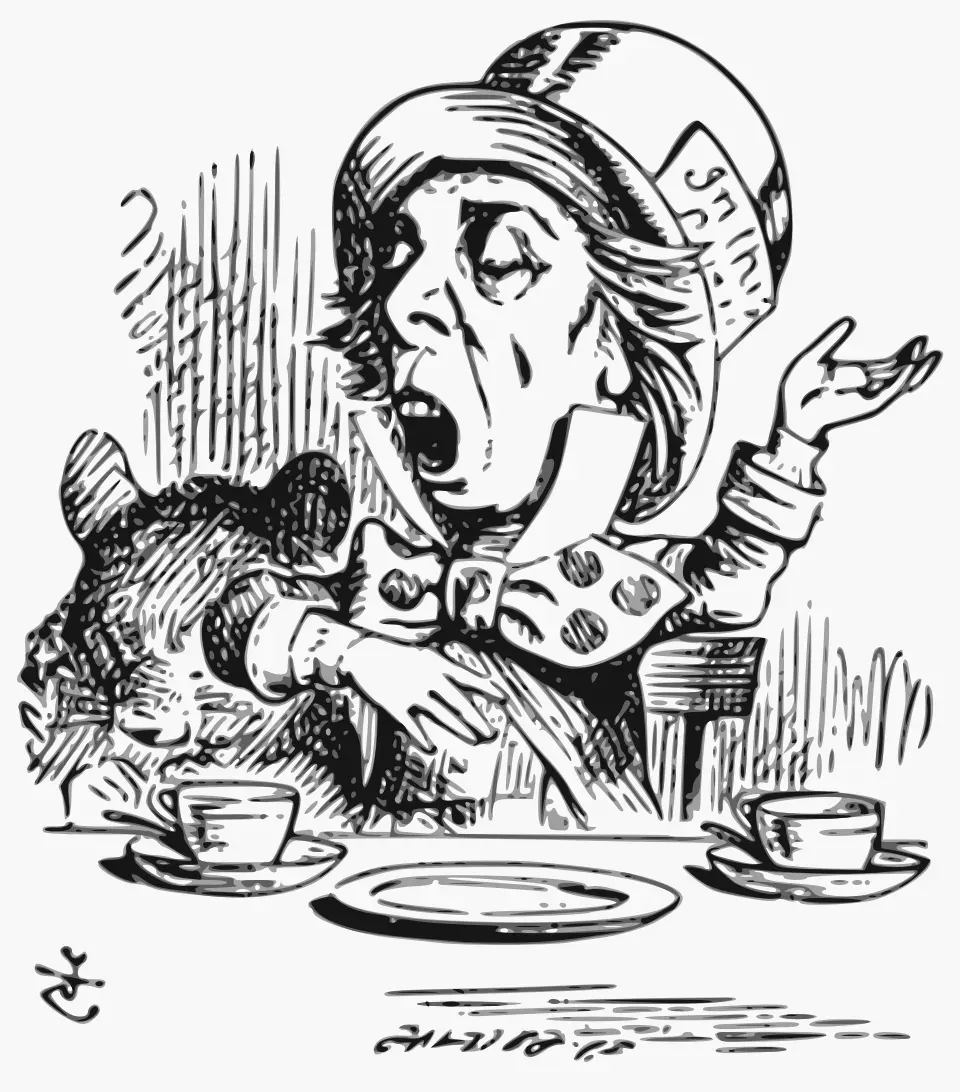
In this guest post, transcribed from his excellent thread on our Discord, Gemelli explains how he's designed the Mad Hatter as a Hollows battle. You can read more about designing for Hollows here, and join our big boss monster game jam here.
First Draft
I'll talk through the process of designing this entity, which I need to emphasize, depicts the Carroll character from public domain, and not the possibly-protected versions from the Disney film or the American McGee video game. This is because I am a rank coward.
The big thing I start with is vibes. The whole deal with the Hatter is madness, so I want to lean into that. Lots of scary-insensible laughter and screeching, unpredictable bursts of violence, and things that make the Hunters question their sanity.
I am a sucker for a fight with a phase-change, so I'll build that in. Hatter will start in Lucid mode, and halfway through his health bar, he'll flip to Mad mode. (This is a mechanic you can see done really well in Chris Taylor's Forcross Remedial Academy Hollow, with the Thrice-Bound Sow.)
I tend to like entities whose defenses are a little higher than the book suggests – I usually go for 10/12/12 instead of 8/10/12, and tend to have Close defense set to 12 as the default because most Hunters attack from Close. In this case, I'm going to go even a little higher on ranged defense, because I'm thinking that the defenses will shift a bit at the phase change.
So I'll start with base stats of:
Close: 12 :: Ranged: 14 :: Wyrd: 10
Resolve: 6 :: Wounds: 14
The low resolve means that this thing will break early and often. Let's give it a fun effect that causes things to shift some stats around:
WHEN BROKEN (every time):
Clean Cups, Move Down! The Hatter's confusing screech somehow compels your legs into action. All Hunters are repositioned to the next area clockwise (Hunters in Ranged Left move to Rear, and the GM chooses for each Hunter in Rear to move to Flank Right or Ranged Right). Reduce the Entity’s Ranged Defense by 2 (minimum 8), and increase its Close Defense by 1 (maximum 18).
This makes me feel better about the starting Defenses being higher than usual; every time the Entity breaks, the Entity gets significantly easier to hit from Ranged. I'm thinking that he's a spry motherfucker, skipping all over the place, and that over time your constant abuse starts to slow him down and turtle up.
Looking back at the idea that I want this thing to question the Hunters' sanity: this can be a sensitive area for games and gamers, so I don't want it to be too dark. In fact, let's give it an advantage as well as a downside.
SPECIAL RULE:
You’re Mad. I’m Mad. What’s happening? Why does nothing make sense all of a sudden? A Hunter with a Curse token is Mad. Mad Hunters roll with disadvantage on their attacks, and subtract 2 from their defense rolls. (Max one Curse per Hunter.) A Hunter entering support immediately clears their Curse token.
And we'll incorporate the phase change idea into a special rule as well:
SPECIAL RULE:
We’re All Mad Here. Battered beyond insensibility, the world around him begins to warp into incomprehensible new shapes. The Hatter starts the fight in the Lucid phase, and changes to the Mad phase when its health drops to 7 wounds and below. The Entity’s phase determines which attacks and maneuvers are available on its turn.
(Side note: yes, I know that quote comes from the Cheshire Cat, not the Hatter. As an uncultured philistine, I will not be shackled to literary precedents.)
This establishes the broad vibe I'm looking at, so let's wrap it up with the terrain overview:
TERRAIN:
An enormous table and chairs to match, all sized about twice as big as you’d expect. 4 Elevated, 2 Sheltered
Having more elevation than shelter matches how I think the scene would look, and gives the Hunters a simple way to get around that high ranged defense at the start of the fight.
I'd like to mess with the scene a little during the phase change, but I haven't decided exactly how, yet.
My thinking right now about the phase change is that it will swap out one Entity attack, and one Entity manoeuvre, into new versions. This helps keep the fight interesting to play (and also for the GM to run) while still leaving the players with a good understanding of what to expect from most of the Entity's actions.
(If you swap out everything during a phase change, it can feel overwhelming, so usually you want to keep this sort of simple when possible.)
On that note, let's start with a simple set of Interrupts.
By default, having two Interrupts, two attacks, and two manoeuvres is a great baseline for a fight. Having more Interrupts makes the Entity more adaptable, especially against larger groups of Hunters. Having more attacks can give the GM fun tools to bring out, but can be confusing for the players (being able to learn Entity actions, and come up with counter-play, is part of the fun).
INTERRUPTS:
Teacup Volley. His arms blur as he pulls one teacup after another from the air, flinging them towards you. Cost: 1 Threat. Target one Ranged area. All Hunters in that area check Quick TN6, 2/3.
Hat Trick. His enormous, horrifying hat comes plunging down, aimed directly at your own head. Cost: 1 Threat. Target one Hunter in Close, Hard TN10 3/2. On a failure, that Hunter gains a Curse token.
The first one is an area-of-effect Interrupt, so I've lowered the TN quite a bit to compensate. The second one is a single target so it can be a little harder to avoid.
Note that Interrupts require you to have Threat in the area that you're targeting. So while these give me a good set of toys for messing with the Hunters between their turns, there is counterplay available: Hunters can position themselves where the Threat isn't.
This is an important point for my designs: I typically try to avoid making highly lethal attacks that Hunters have no opportunity to avoid. If it's going to potentially hit you for 5+ wounds, it should be telegraphed a bit, or have a specific targeting condition that the players can learn.
Fight intro follows along pretty easily from the vibes:
There’s an enormous table, set for afternoon tea, sitting under a tree in front of a lovely house. Dozens of places are set with plates and teacups, but only three places are occupied. The two seats surrounding the head of the table are occupied by withered, shrivelled animal corpses – some sort of rabbit that seems to be held together with baling wire, and an enormous black mouse inexplicably wearing red shorts with two large white buttons on the front. Sitting between them is a creature dozens of feet tall: corpse-pale skin and gleaming red eyes, wearing an enormous green hat, and pouring himself black, syrupy sludge from an enormous teapot. His eyes lock onto yours as you step into the clearing, and your senses immediately react as if you’d just ingested something very, very potent.
REVISIONS
I decided during my actual day job meeting that I can simplify the fight a little bit by reducing the number of entity actions that change from Lucid to Mad.
We go with just one manoeuvre on top of the standard entity manoeuvres (Prowl, Turn Around, and Shrug Off), because I don't think we need more than that:
MANOEUVRE:
Six Impossible Things. Visions of eldritch, non-Euclidian objects swim into your vision, and your brain recoils. Target one Hunter in any area, or spend 1 Resolve to target two Hunters in any areas (not Support). Targeted Hunters test Wise; on a failure, that Hunter gains a Curse token, and is shifted into an adjacent area, along with any Threat tokens from their original area.
My Interrupts are targeting two different stats – Quick and Hard – and now I've introduced a third stat (Wise) that this Entity will be targeting. I'm going to leave it at that, meaning that I will commit to having the entity's attacks only test these three stats.
You can absolutely target all five stats with a single Entity, but my experience is that this does not result in a fun fight for anyone. Two stats for a beginner Entity, and three for most others, is a good place to start.
I thought a little more about what else I'd want to be different when flipping from Lucid to Mad. A phase change in a fight should feel powerful and scary, with the background music ratcheting up to the next level of intensity, and your description should very much signal that the kid gloves are coming off.
One obvious flip would be to lean into the size changing that factors into the original story. For now, I revise the phase rules to match that:
We’re All Mad Here. Battered into insensibility, the world around him begins to warp into incomprehensible new shapes. The Hatter starts the fight in the Lucid phase. When its health drops to 7 wounds or below, restore the Entity’s resolve to 6 and switch it to the Mad phase: The world spins and twists, and you feel yourself shrinking, table and chair legs suddenly looming impossibly tall.
The entity’s phase determines which attacks and maneuvers are available on its turn. In addition: during the Mad phase, Hunters claiming an Elevated terrain tag must spend 1 Resolve before it is claimed (this happens after a Take Cover roll). Attacks with Elevated terrain add +1/+1 to their base damage.
Here's an important thing to call out, since I'm doing this stream of consciousness style: I have no idea whether any of this will end up in the final design. I fully expect that there will be lots of things that sound good on paper, but when you bring them into an actual game, they end up hitting the stage like wet clay. That said, you have to start somewhere, so I tend to play fast and loose with my first drafts. Paint the complete picture first, and go back later to clean it up.
(At least, that's what I do. Your mileage may vary.)
So, we've talked about the phase change a little, and established that it'll add a cost/benefit tradeoff for gaining Elevated terrain. What else should be different between the phases?
My initial thinking is that phase 1 will be a little more defensive, so maybe that phase-specific attack can offer some resolve restoration. And then phase 2 flips into total aggro, with a sprint to the finish, so that phase-specific will focus on deadly single-target attacks that can turn Curse into damage enhancement.
We start with the attack that DOESN'T change from phase to phase:
Ravens and Writing Desks. An ink-laden quill slashes through the air, and the room is suddenly filled with enormous, black, startled birds. Target all Hunters in two adjacent Close areas, Quick TN7 2/2. Any Hunter taking damage gains Curse.
Then the Lucid-phase-specific attack::
Treacle, Treacle. The mouse corpse twitches, and you can feel some unseen essence draining invisibly from your body. Target any number of Hunters in Close with Curse tokens, Wise TN6 3/3. For each Hunter that takes damage, the Hunter loses their Curse token, and the Entity restores 2 Resolve.
And finally the Mad-phase-specific attack:
Un-Birthday Party. The horrible, dissonant music that suddenly blares through the room defies description. Target one Hunter in Close, Hard TN12 4/4. Before the defense roll, you may consume Curse tokens from any Hunters in Close to add +1/+1 to the attack for each consumed token.
And do you know what that is? That is a full-fledged complete god damn entity design, ready for prodding and revision.
I'll sit on it for a day or so, and when I think it's ready, I'll run a solo-test fight or two to see if it still feels fun.
When it's done, I'll add Doom triggers, and tactics, and layout, and art...
FURTHER REVISIONS
Coming back to this design: having given it some space, I can already see a few things I want to change with it.
First is that some of the Entity abilities just feel... flat. Everything the Entity does should feel dangerous, and visceral. An ability that's just "he tries to put his enormous hat on your head" does not pack the narrative punch you want in a boss fight.
So: Hat Trick goes out, and is replaced by this mechanically identical interrupt:
Porcelain Shards. A teacup, crushed effortlessly in his hand, becomes a jagged weapon seeking the softest parts of your face. Cost: 1 Threat. Target one Hunter in Close, Hard TN10 3/2. On a failure, the Hunter gains a Curse token.
The other interrupt, Teacup Volley, looks pretty good, but I think that 3 Wounds is too much for a one-Threat-cost interrupt that hits multiple Hunters in one area. Reducing that one to 2/2.
The main attack, Ravens and Writing Desks, is also likely too strong in being able to target all Hunters in two Close areas.
Especially with the attack giving out Curse tokens, as I think those are going to make attacks a lot less likely to land.
I'll tweak it a little bit as follows:
Ravens and Writing Desks. An ink-laden quill slashes through the air, and the room is suddenly filled with enormous, black, startled birds. Target all Hunters in a single Close area, or spend 3 Threat from Close to target all Hunters in two adjacent Close areas, Quick TN7 2/2. Any Hunter taking Wound damage gains a Curse token.
When thinking about defenses from Entity attacks and Interrupts, it's good to keep in mind what stats Hunters are likely to have.
Folks in Close will typically have fairly high Quick or Strong. Folks in Ranged will typically have higher Sharp and Wise. Hard is typically only boosted for Hunters that are expecting to tank a lot of hits in close, so Porcelain Shards is likely to result in failed rolls pretty regularly. It's a higher damage output than the main attack because it's single-target, and because I want to be sure that a Hunter taking Sheltered terrain can't just park and ignore all the damage.
On the phase-specific attacks, I do like the theme of resolve restoration, but this is the sort of thing you need to be careful with. Too much restoration makes the fight feel like a slow slog where the players are fighting a constant uphill battle.
So, I'll change the attack to be a little less punishing and make the Resolve restoration a little harder to get:
Treacle, Treacle (Lucid Phase only). The mouse corpse twitches, mouth opening, and you can feel some unseen essence draining invisibly from your body. Target any number of Hunters in Close with Curse tokens, Wise TN6 2/2. For each Hunter that takes Wound damage, the Hunter loses their Curse token, and the Entity restores 2 Resolve.
Because we've said that Hunters with Curse tokens get -2 to their defense rolls, it will be a little easier for them to avoid the wound damage.
And then on the Un-Birthday Party (Mad-Phase attack), I need to ratchet up the horror, but also set up a targeting condition, as it can absolutely be a one-shot-kill attack in the right circumstance:
Un-Birthday Party (Mad Phase only). Horrible, dissonant music blares as the creature vomits a torrent of glitter and porcelain shards at you. Target one Hunter with a Curse token in Close, Hard TN12 4/4. Before the defense roll, you may consume Curse tokens from any Hunters in Close to add +1/+1 to the attack for each consumed token.
The final thing I want to do is revisit the When Broken effect. The full-grid repositioning is going to create chaos, but I think we can set up some cool Hunter decisions by changing how the defenses are adjusted:
Clean Cups, Move Down! The creature's screech somehow compels your legs into action. All Hunters are repositioned to the next area clockwise (Hunters in Ranged Left move to Rear, and the GM chooses for each Hunter in Rear to move to Flank Right or Ranged Right). Reduce the Entity’s highest defense by 2 (to a minimum of 8, GM chooses defense to reduce on a tie), and then rotate its defenses (Close to Wyrd, Ranged to Close, Wyrd to Ranged).
In general, a rule that requires lots of parentheses to explain is not a good rule, so I'll sit on this and see if I can come up with something more elegant.
I think this is a pretty good start! Here's the Entity for you to take a look at.
If you'd like to make your own monster for Hollows, come join the jam!