The Mighty and Esteemed Tactical Grid
What's the tactical grid for, in Hollows, and how does it work? How do we make lock-on targeting work in a TTRPG?
Hey. Before I hand over to Grant “Yes, That One” Howitt to talk about his game… this is an article about Hollows, our game of wretched suffering and resilience (and Weapons powered by toxic masculinity. And big monsters.) in a grim Victoriana setting. If you don’t know what Hollows is, you can read about it here. - Producer Chant
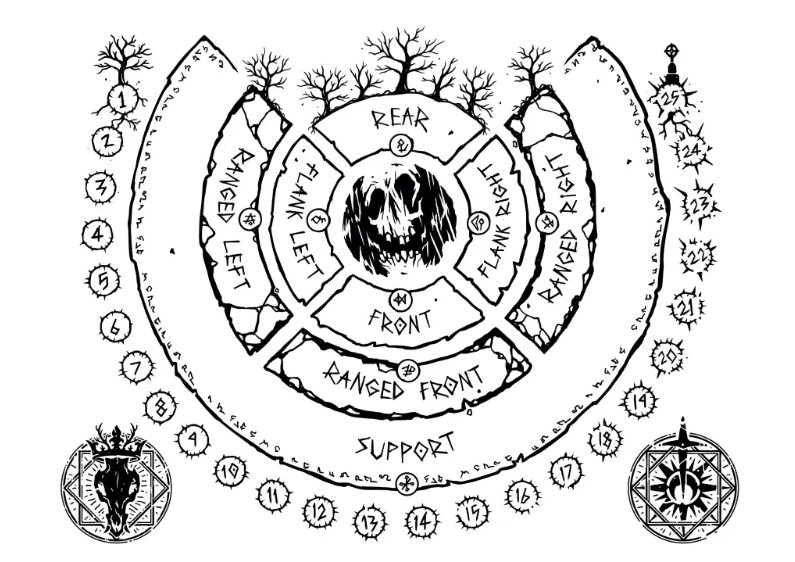
The core of Hollows combat is the tactical grid, designed by visionary powerhouse Chris Taylor after no fewer than nine drafts of the game. My pitch, by the way, was to do all fights on an image of a moody-looking location split up into abstracted zones tagged with keywords (Defensible, Dangerous, Precarious, Elevated, etc) so I’m glad that he stuck to his guns and we ended up with something novel.
The tactical grid is an attempt to boil down the positioning needed to make a big fight interesting to eight potential spaces you can stand and have it matter. We have four Close areas (Front, Right and Left Flank, and Rear), three Ranged ones (Front, Right and Left Flank) and Support, which is more of a concept than a physical location, and represents breaking line of sight with the enemy so you can recover. Technically the enemy also gets a space, but generally when you end up in there it's because you’ve been swallowed, so I’d stay out of it if I were you.
Inspirations
Of course, the tactical grid didn’t spring fully-formed out of Chris’ divine brow one fine day in spring; the pair of us have about seventy years of gaming experience aggregate between us, and we’ve seen plenty of things that we decided to draw on, steal from, file the serial numbers off of and generally bastardise into something functional.
Lock-on Targeting
This term will be immediately familiar to anyone who’s played a videogame in the last thirty years, but just in case you’re a dyed-in-the-wool traditionalist and all you know is pencil and paper, lock-on targeting is a toggle in some video games where your avatar’s attention can be focused on a single target. The first time I saw it was in Ocarina of Time on the N64, but I’m sure it’s been around since we worked out how to squeeze that third dimension into a virtual space. I bet Tomb Raider had it.
When you lock on to something - usually by pointing your reticule at it and tapping a button - your character will face towards their target at all times. All movement is translated with the requirement that, whatever buttons you push, you’ll be facing whatever it is you want to fight and your attacks will go towards it.
While this helps pick out individual targets in a swirling melee, the most useful application for it is in boss fights for games like Dark Souls (or Bloodborne, Elden Ring, any Fromsoft Fucked Up Little Man simulator you care to mention, or any of the hundreds of imitators that dared to answer the question “What if computer games were difficult again?”). Reading a boss’s behaviour and getting out of the way of danger - or parrying it, if you’re brave (I’m not) - is paramount to surviving and therefore winning these fights. Locking on to the big monster while you're fighting it means you're always aware of what it's doing and where you are in relation to it.
Coupled with the ability to summon chums to help you out, boss battles in Dark Souls usually look like two to four little guys quite literally running circles around a honking great lumbering monster and making last-second dodge rolls to avoid being pummeled into mince. (So, you know. Just like Hollows.)
The One Ring RPG
The Lord of the Rings has had many fine adaptations throughout the century since its creation - I’m a fan of the BBC radio drama myself, where Aragorn sounds like a nasal insurance salesman - but it’s no easy feat to adapt what is almost universally-regarded as the fantasy ideal into a game, and there’s been plenty of swings and misses (and hits!) in an attempt to turn An Unfathomably Long Walk To Return Some Unwanted Jewellery into an accessible rules-set for laypeople at the table.
The One Ring does some lovely stuff with journeys, morale and how much the people at home forget you thanks to the Unfathomably Long Walk you’re on, but my favourite bit was how they did combat.
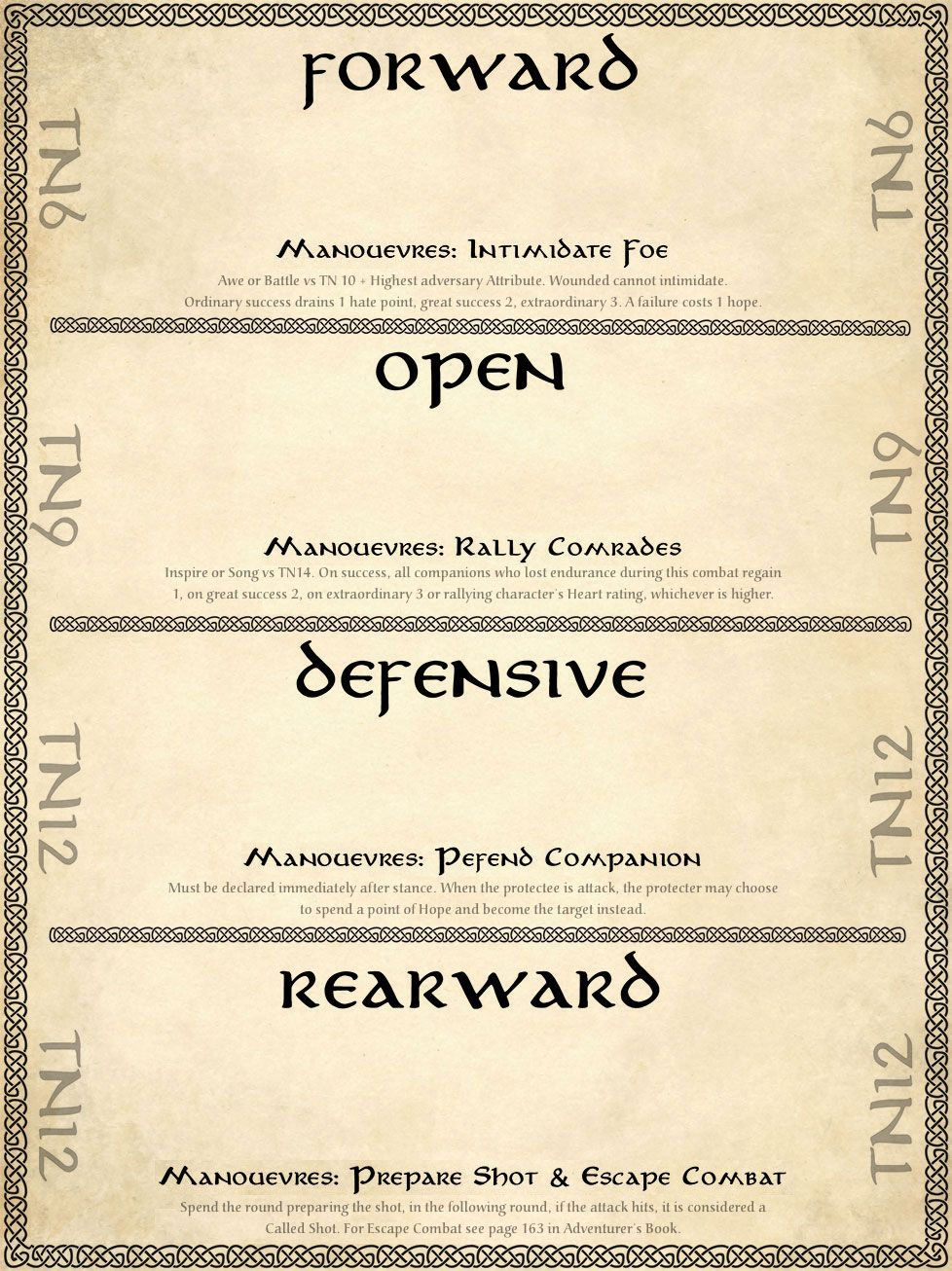
Again, while I’m sure it (or something very similar) had been done before, The One Ring’s combat system spoke to me. Instead of trying to work out the exact position of each combatant, it gives players areas they can occupy that exist in relation to the bulk of the enemy forces.
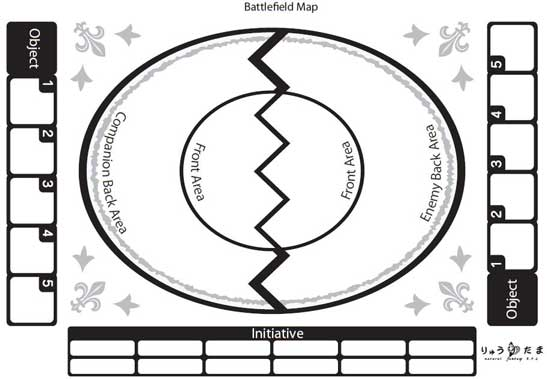
There’s a slightly less complex version in Ryuutama, the best game I’ve ever read with regards to the fashionability of umbrellas:
And, for those of us that don’t want to use maps at all - which is me, most of the time - abstract range bands like Engaged, Nearby and Far Away used in 13th Age give us a tidy, if sometimes indistinct, way of representing fictional position in terms of relative distance instead of geographical details.
The Secret World
Or, really, any MMO you care to mention - I chose TSW because it’s the only one I’ve dedicated any significant time to. Chris, Maz and I would spend evenings in late 2015 three-manning five-man dungeons because Chris is a sucker for punishment and I struggle to play games with anyone other than my very understanding close friends. (Maz liked it when the numbers were big, and they didn’t have to share those big numbers with anyone else.)
We had our roles set:
Maz was the DPS, or “damage per second” to use the full term, and their job was to push a preordained series of buttons on their keyboard in the correct order to maximise their damage output whilst trying earnestly not to die. They would concoct combinations of abilities that absolutely baffled me, and often remember more than four things at once, which I am fully incapable of.
Chris was the Healer, because that meant that he could tell us all what to do under the pretense of keeping us alive. It was useful, given his extensive knowledge of MMOs in general, to have someone calling the shots. It was his job to watch our health bars and make sure they never dropped to 0 whilst gently encouraging us to do the correct thing instead of the incorrect thing.
I was the Tank, and my job was to get punched in the face. Or: mauled in the neck by a giant earth elemental, kicked in the chops by a demon queen, gored facewise by a wendigo, whole-head squelched by a Cthulhu. Whatever we faced, if it was going to attack someone, ideally that someone would be me - and who it attacked depended on who it was facing, who was closest, and who had pissed it off recently. I had some tricks to keep myself alive for a while, but really it came down to Chris’s kind ministrations and Maz’s ability to efficiently empty HP bars before I croaked.
Every fight started with me running as hard as I could towards the baddy, performing the mechanical equivalent of waving my arms and yelling “Hey! Over here!” and hoping that it didn’t realise Chris and Maz were standing off to one side doing all the damage. As long as I could get it looking in the other direction, I was doing over half of my job.
And: we have the same thing in the tactical grid. You can pull the attention of the Entity away from your friends - not always mechanically, but, and this genuinely works, by pissing off the GM enough that they want to attack the guy in Armour at the front instead of the Rifle user on the rear lines. Our attention mechanic, Threat, means that there are better and/or worse places to stand at any given time.
So What Does It Do?
It does boss fights. It does boss fights really well.
I’ve been told that Hollows combat plays a little like a board game, and: good. We made the decision fairly early on to codify the difference between a big boss fight - or a "battle", to use the proper terminology - and any loose violence against inconsequential dorks, which we resolve using a much simpler system of basic stat checks and flat damage output. This was a sizeable change for us, because normally we rely on one system to carry everything through to completion: Spire, for example, uses the same rules for combat as it does for persuasion and stealth, and getting hurt has the same impact mechanically as running out of cash, going mad, or being discovered by the secret police.
But for Hollows, there’s a definite break between Exploration - scrubbing around in the detritus of someone else’s delusions and fears - and Combat. I’m reminded of old-fashioned JRPGs where a fight is accompanied by a graphical and audio cue, and then the action zooms into a turn-based exchange of blows.
We knew that we wanted combat to be detailed enough to be interesting but abstract enough to be fast, and that necessitated coming up with a bunch of specific rules about what you can and can’t do. For example: in your standard TTRPG, if - say - a character had a clever idea about kicking over a rickety stone column to land on an enemy, that’s the sort of thing there’s rules for. Strength check, dodge check for the enemy maybe, probably 4D6 damage, that sort of thing.
We don’t have that. You have your basic actions and that’s all you’re allowed, for balance purposes, and to keep things ticking over as fights become more complex. Feel free to describe kicking stuff over, it’s just that we’ll just treat it as a regular attack with one of your Weapons in mechanical terms. In fact, one of the most important things to remember when you commit to bloodshed is that it’s not an excuse to stop roleplaying - the game is about fighting. Your characters are about fighting, defined by their Weapons and the scars that repeated deaths have left on them.
Combat is an opportunity to roleplay. It’s exciting, it’s vigorous, it matters. I’m reminded - perhaps incongruously - of the difference between the sex scenes in Game of Thrones and Heated Rivalry. (Stick with me.) In GoT the sex scenes were discounted by detractors as a means of spicing up otherwise boring plot points with some wobbly bits on screen, and they rarely showed us more of a character’s motivations or internal conflict. In the more recent gay ice hockey drama Heated Rivalry, the sex scenes are a means of heightening the stakes and intimacy between characters whilst providing a portrayal of who they are, how they feel about one another, and what they’re after.
It’s good stuff! It’s titillating and it’s dramatic. And I feel like a good Hollows fight, with the abstractions in place and the propensity for characters to get crushed to pulp, can occupy a similar position if you do it right.
Threat
To return to Dark Souls, briefly: far more boss-fighting time in a Fromsoft game is dedicated to getting out of the way of attacks than it is actually performing them. Reading an enemy’s behaviour, often learned from multiple runs at the same bad guy, is crucial. Figuring out which of their attacks are which, when to move and when to stand still, when to parry and when to dodge, when to run away and when to press the attack - thesea are all absolutely vital.
Now, in a tabletop game - especially one as brisk as Hollows - we don’t have the sort of abstract fidelity required to translate yer Ornsteins and Smoughs 1:1. But we have a way of telegraphing attacks, which is to say warning players ahead of time that a big hit is coming, and that’s Threat.
Threat tokens - little cubes in the component kit; I wanted to use resin teeth but I was told that was “too expensive” and “creepy” - represent an Entity’s attention, and they’re placed in two ways:
- At the end of an Entity’s turn, as it looks around the arena and works out who it wants to smash to bits next
- After a Hunter inflicts damage to an Entity, as they draw its attention
And the Entity can spend Threat in two ways:
- Triggering an Interrupt action, which happens between player turns and allows an Entity to balance out the uneven action economy somewhat. Usually these are light attacks, or tricks that position Hunters into more useful positions for a big hit. Most Interrupts cost 1 Threat, but powerful or exciting ones can ask you to spend more
- Enhancing an Attack on its turn; each Threat spent increases a player’s defence roll by 2, and seeing as this is a roll-under system, 2 Threat can push the likelihood of a wounding hit up by 20%
Spear users (and to a lesser extent, Armour and Sword users) can mess around with Threat, either shifting or removing it, and doing so is crucial to not dying on turn three. GMs, at first you will hate Spear users, and then you will learn that you are both performing a dance as old as time, and each Threat they clear off the grid brings them closer to a deadly wounding hit, and soon you’ll be surprised if they’re not hoovering up all the loose attention like a bloody roomba every round.
The best part about Threat - for me, at least - is how it lets us warn players ahead of time. “Don’t stand here,” it says, “or I’ll hit you!” And if they stand there anyway, it’s their fault they got hit and killed. We tried to tell them; it's not our fault they didn’t listen. And if a player feels like it’s their fault that their character died, not ours, they’re usually much happier to gear back up for another go and try to do it right this time.
Terrain, and How It Works
Once you strip away the idea of a map having any relation to the land around it, you start to struggle with the idea of Things being there in any logical way. We couldn’t have terrain on the grid because the grid is just a way of showing which direction the Entity is facing, effectively, so after much back-and-forth we decided that terrain should be something you do rather than somewhere you are.
So - when you Take Cover, you get a terrain tag. They’re divided into Sheltered (stuff you can hide behind to avoid damage) and Elevated (stuff you can stand on to get a better hit in); the Staff gets its own pet terrain tag, the Briar, which starts doing really disruptive stuff once you upgrade it with suitable abilities. Each comes with a stat check you have to make to do it properly, else you draw the attention of the Entity (and place a Threat on your area) or tire yourself out a bit (and lose 1 Resolve).
When you move out of your area (or are Shifted out thanks to an Entity action), you lose the tag. When you’re Repositioned - a keyword we use when, in fiction, the Entity is moving instead of you - you keep it. When you attempt to claim a terrain tag that's the same flavour as one that someone’s already carrying in your area, you roll with advantage on the stat check to claim it without costs; we wanted to offer some incentive for grouping up around a feature that already exists, because it helps make the often quite abstract world feel a bit more concrete.
Some Hunter abilities destroy terrain tags - and there’s a limited supply, so you need to balance the tactical advantage of soaking some damage or rolling with advantage to hit with whatever wild shit you’ve got planned on your turn. The Bludgeon lets you topple a structure on top of the Entity to inflict a bunch of damage (so you can do that pillar kick from earlier, I suppose, there’s just a lot of steps in the way to do it mechanically); the Staff eats buildings for power and uses them to heal Hunters (even dead ones) or unleash big magical attacks.
Entities That Use the Grid Interestingly
So far I’ve talked about the grid in pretty general terms, and examined what every Entity can do. But much of the fun of Entity design comes from picking one or two rules to invert, subvert or entirely ignore and seeing how that changes the flow of play.
Here’s a few examples of Entities that (in my opinion, and I wrote half of them, so take of what what you will) change it up in a novel way:
The Fool (Hollows, p284) has two (or more!) hands attached to long snaking arms that it whips clockwise around the arena to slap and grab Hunters; when they enter Rear, the GM can choose to put them in the Ranged or Close bands, but aside from that brief liberty the hands do their own thing.
The Regiment (Hollows, p300) I mentioned earlier blocks access to Support when it’s at half Resolve or higher, representing the soldiers surrounding you and cutting off your angles of escape. It doesn’t do a great deal of damage until it gets powered up with Threat - i.e. the enemy gets a bead on you and prepares for a proper fusilade - but you’ll struggle to stay alive if you’re used to dashing in and out of safety.
Miss Gatwood (The Forcross Remedial Foundation and the Imaginary Inhabitants Therein, p22) pulls the stage curtains behind her closed (and removes the Rear area entirely) and shunts every Hunter out to Support when first broken, so they must march sullenly back to the fight accruing Curse as they go. She also has different attacks in different areas, representing her trusty Smacking Ruler.
The Kiln Witch (The Polychrome Sea, p17) places Threat on the borders between areas, not the areas themselves - and it can be spent to affect either, as well as inflicting Resolve damage if Hunters attempt to cross the thicket of barbed ceramic trees.
Getting Weird With The Grid
As soon as players got their hands on Hollows, they immediately started doing things with the tactical grid that we hadn’t tried. Turns out there are a lot of ways to adapt this concept, once you’ve got it.
SpatialWarp off the Rowan, Rook & Decard Discord did... something with the grid. Here it is:
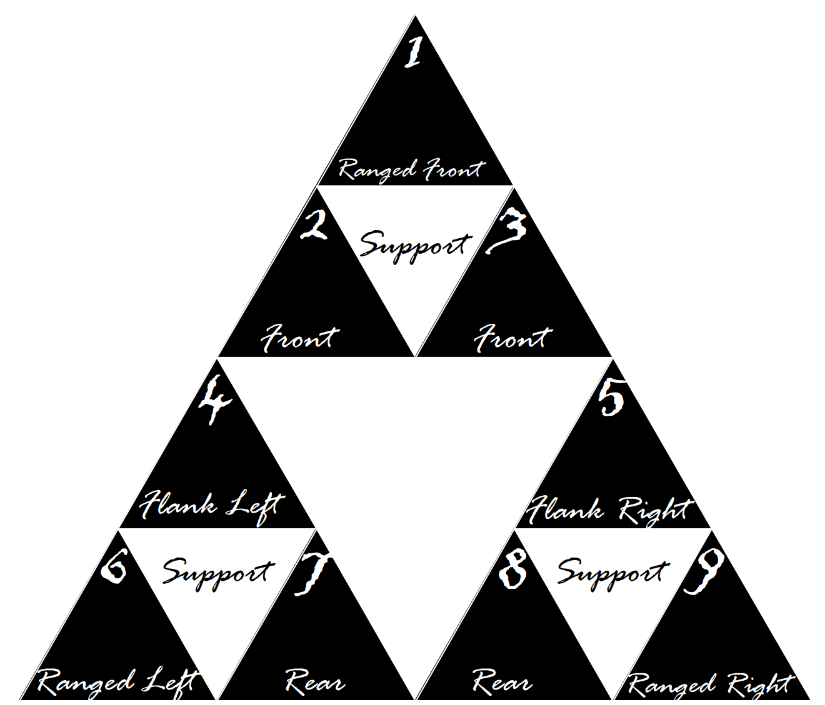
I don’t know what it does and I shan’t attempt to understand. I am told Support didn’t exist unless the Entity was Broken.
Number one Hollows fan Gemelli set up a zerg rush style fight called The Crawlers, inverting the grid to put the players in the middle and a bunch of guys around the outside:
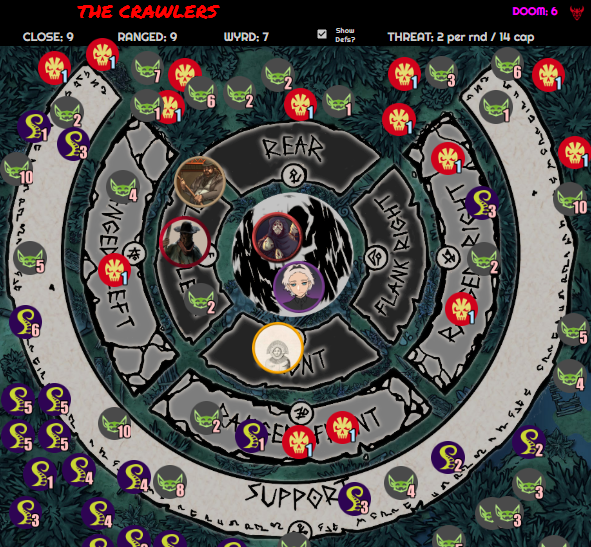
We played around with a similar idea for the Regiment in the first draft - we wanted to have the players defending the Refuge, and maybe have a timed “holding out” mechanic where they had to survive for X turns until... something happened? But it was too much of an inversion, too many things back to front, and we made the decision to abstract the individual combat versus soldiers and officers into the regular Resolve and Wounds system.
In Closing
Just like our slightly unfamiliar blackjack-style rolling system - where you’re rolling under one number but over another to generate the best result - it can take a little bit to get used to the tactical grid.
It’s different from what we’ve done before - and, I hope, different from pretty much anything we’ve encountered in roleplaying games. It feels different, it plays different, and it was a big swing for us. But I believe it worked, and I hope that once you give it a go, you believe so too.
You can download the Hollows Quickstart, The Sins of Grisham Priory, for free here if you’d like to learn more.