
Come build a monster in the Hollows Entity Jam
Want to build a monster with us? Come on in
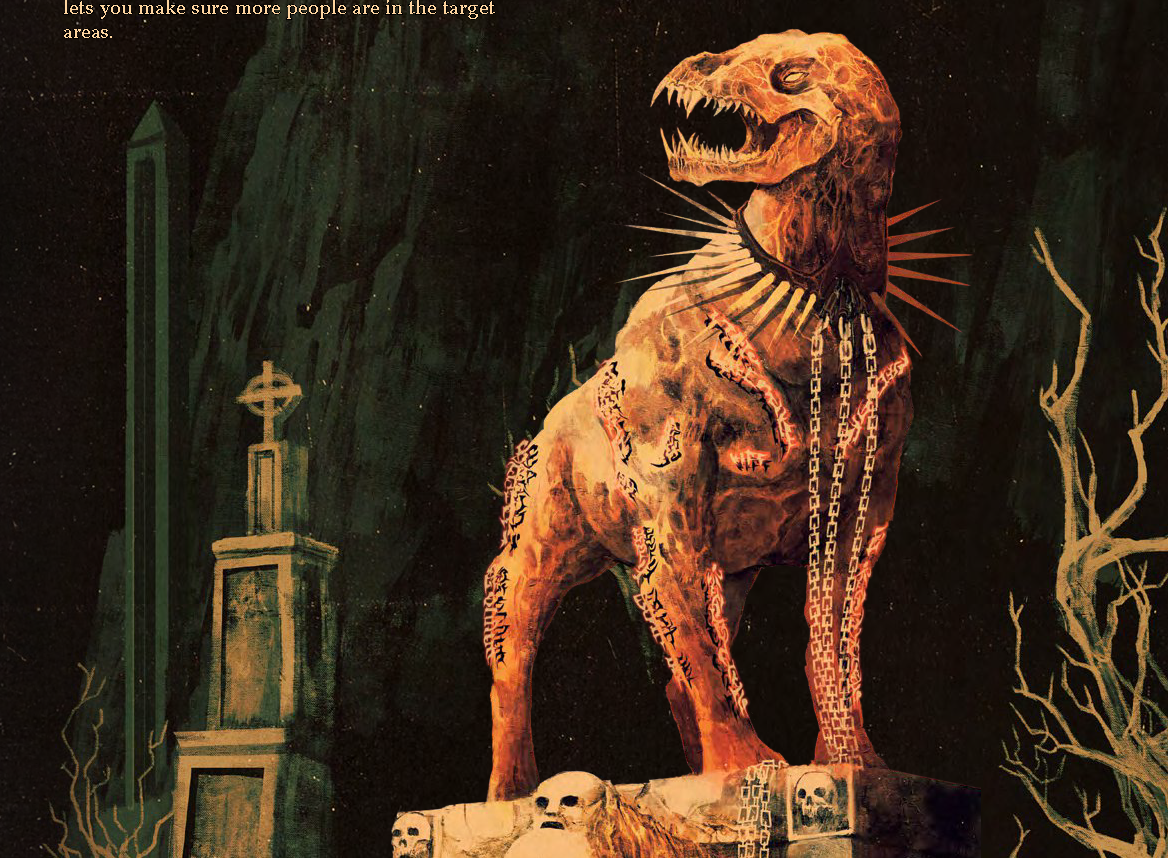
Want to build a monster with us? Come on in. Our Hollows Entity game jam is open to everyone; it's easier to play along if you’re one of the 2,500+ people who already has a PDF copy of Hollows, and knows what an Entity is and how they work, but we want to make it accessible for everyone, even if you've never heard of Hollows before.
Quite frankly, the monsters are one of the best things about Hollows, and we’re hoping you’ll have a play around with the rules, come to the same conclusion, and then maybe have a great time making more Hollows stuff.
If you'd like to get involved, start out by picking up the free Hollows quickstart, The Sins of Grisham Priory. It's got rules for combat that explain how the game works, along with four sample Entities you can use to get a sense of how to build and fight our big boss monsters, and copies of the combat grid and tokens that you can print out to play with at home.
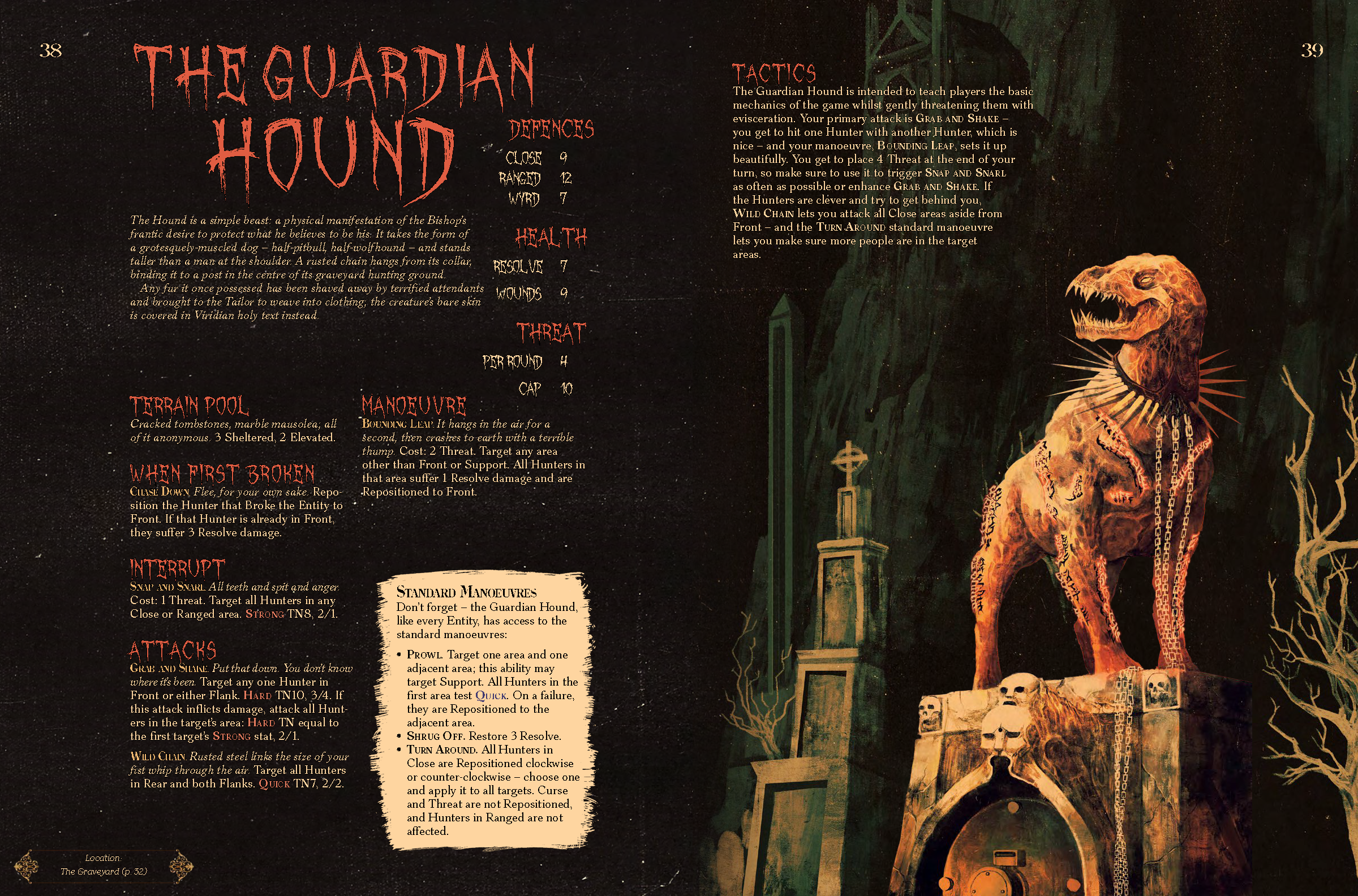
If you've already got your Hollows PDF - well, there are 11 full pages on designing Entities, and we reckon those are a better tutorial than what we can give you here. But Grant's going to design a horrible horse monstrosity in a bit, so you might still want to read the rest of this post.
What Are Entities?
Entities are boss monsters. They’re your liches, your ancient red dragons, or for weaker characters, your dire bears and stuff. In the actual setting of Hollows, they’re the Lords of personal Hollows: the worst people in the world, souls poisoned by malignant godlings and trapped in their own recriminatory psychodrama. Or they’re Vassals, quasi-real (real inasmuch as they can definitely kill you; probably couldn’t exist in the real world) beings provided by the Hollow to both torment and protect the Lord.
But: you don’t have to make a monster that would fit in our Hollows, just something that will give players the fight of their lives.
(If you want piddly little mobs, we have something called Thralls, and I’m not explaining them here because this is going to be such a long post anyway.)
[GRANT] To show you how this all works, I’ll make an Entity as an example at each step. I was editing the blog post, and I suggested it, so really I ought to put my money where my mouth is.
Here’s the deal: I have to run Hollows at World’s Lair in a couple of weeks, which means I’ll need an Entity for the players to fight. It has to be simple enough to work on stage but clever enough to show off the mechanics a bit.
I’m loath to do additional work so I’m going to make this blog serve double duty. I’m making a Fear Entity - Fear being one of the malignant godlings that Chant mentioned above that makes people into monsters - which, to me, are lanky Dark Souls-looking nightmares.
In fact, you know what’s scary? Horses. I’m terrified of them. And they’re perpetually on the edge of a lunatic episode, too. Which gives us Fear both ways, so let’s get Ludwig the Accursed with it and gin up an equine monstrosity.
Where Do Fights Happen?
Lairs. Crypts. Sky palaces. The usual. More importantly, on Hollows’ bespoke combat grid, where the Entity is always in the middle and the player characters move around it.
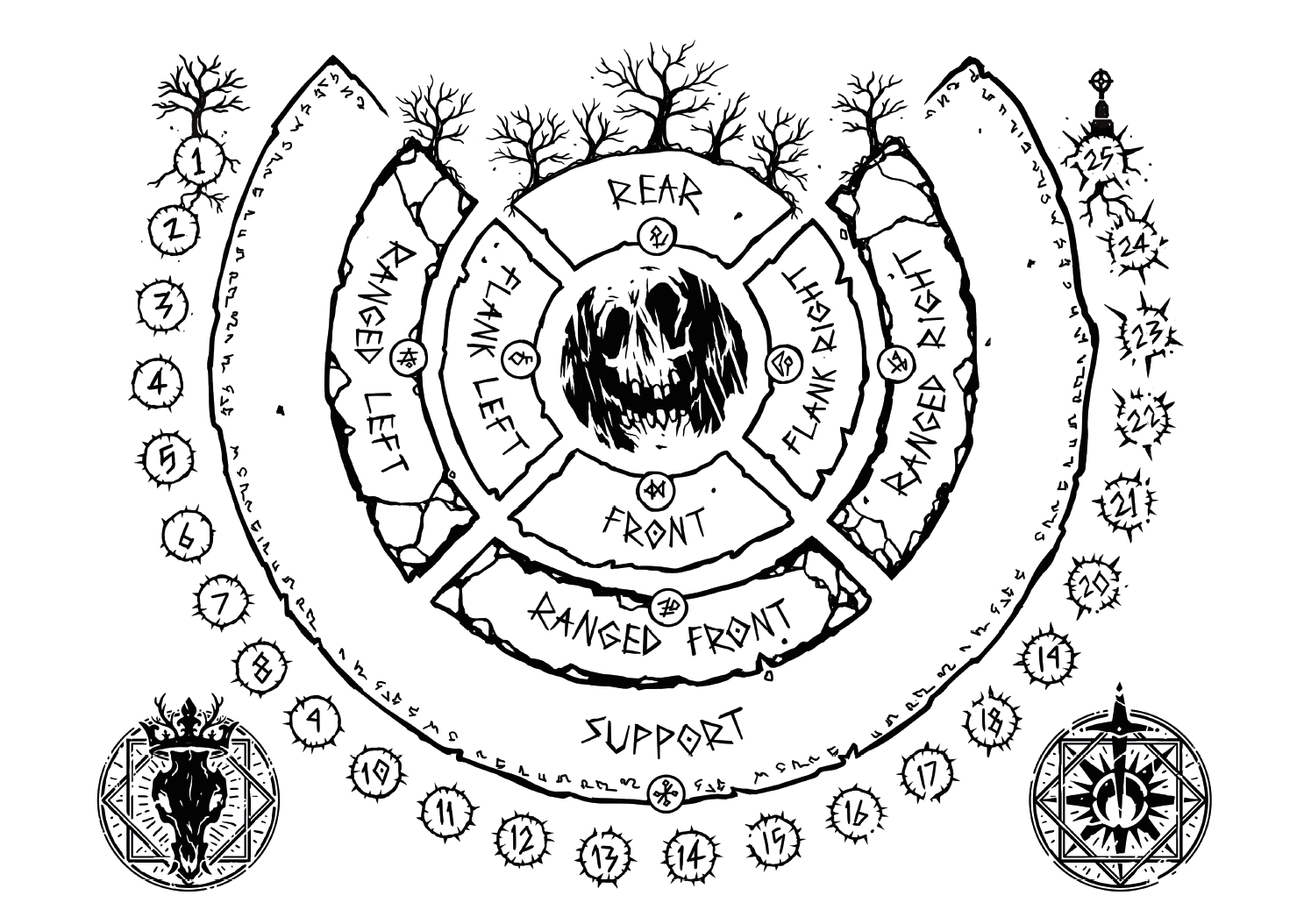
Characters’ position is defined by where they are relative to the Entity: Close (melee distance) or Ranged (firearm distance), directly in front of or behind, left or right. And there’s Support, which is technically off the battlefield: a safe(ish) place where Hunters can go to heal up, if they’re cowards. Entities can’t usually attack it directly, but we break our own rule sometimes - if the monster’s really big, or we’re sick of players getting things their own way.
There are three ways to move on the grid:
Move action - for player characters. The little guy/gal/other moves to a different position.
Reposition keyword - the Entity moves, but because the fight moves around them, the player character’s token is repositioned to a different point on the grid to represent how their position changes relative to the monster.
Shift keyword - the Entity physically intervenes and puts a Hunter somewhere else: vaporises them at an atomic level and reforms them on the other side of the arena, lures them closer with a beguiling song, or just kicks them so hard they land in another postcode. This is usually worse for Hunters than any of the alternatives. (This is also how you yeet one Hunter into another Hunter, converting both Hunters’ bones to fine sand.)
What are the Resources?
Hollows has three resources that Entities use or regularly interact with.
Threat tokens are a measure of how much attention the Entity is paying to any part of the battlefield. Entities place some at the end of their turns, and players place it on their areas when they land a successful attack. The GM can use it to increase how dangerous an Entity’s attack is, or use it to power Interrupt actions (see later).
Terrain tokens are something that Hunters (player characters) hold to show when they’re making use of battlefield features. They can be Sheltered (reduce incoming damage) or Elevated (increase accuracy). You can make Entity abilities that do more/less damage when a target has terrain, destroy terrain, force players out of or into it (usually an advantage for them, but not if, say, you’ve got another ability that does extra damage to characters with terrain).
Curse is our default “weird stuff” mechanic. Curse counters are D6s, and can have values from 1 to 6, obviously, or you can just treat it as a binary on/off situation. You can:
- Place Curse on an Entity, either increasing its power by the value on the die or counting up/down to triggering something really terrible that happens when Curse reaches a specific value.
- Place Curse on a grid area, either to represent one of the Entity’s minions (using Curse as its health, its damage output, or both) or a special effect, like the area being on fire.
- Place it on the Hunters, as a kind of debuff (“can’t move from the area if Curse is >=3”; “take 1 point of damage when attacking, if the Hunter has Curse”).
All Entities use Threat. Some use Terrain, Curse, or both. If you’re going to use Curse, make sure the Entity only uses it to do one thing, or the battlemap gets really confusing.
Cool, and the stats?
Entities have fairly complex anatomies, mechanically speaking. Also narratively speaking, in that they’re nightmares made flesh, often with too many or not enough of the parts you’d expect, or bits that would be fine in certain other contexts but are upsetting in this one.
Tactics (aka The Engine)
We start every Entity stat block with a paragraph on tactics. Both because we’re on the GM’s side, and because every Entity is a sophisticated machine with many moving parts. There’s usually a core loop, which can be as simple as “wallop, heal, repeat” or as Machiavellian as “stack as much Curse as you can on yourself while they’re not looking so when you blow up it’s real nasty. Use this manoeuvre to move them into the sweet spot where they take extra damage” or “this Entity’s style is the death of a thousand cuts. You don’t do much damage, but you do it so often there’s no way they can heal it all. Keep your Resolve topped up so you don’t break, and you get a couple more turns to siphon away their miserable pretense at life”.
Figure out your core loop before you start making stats. Pose yourself the question of: how do I want to kill a Hunter? Then make sure the abilities you write achieve that. Ask yourself: is this a big, unstoppable brute that tramples its enemies? Is it frighteningly fast, never quite where you expect it to be when you swing a sword at it? Does it change forms every time it’s broken? If you’ve already got an Entity in mind, hold this thought as you read the rest of this, and squirrel away any passing ideas for how you can pull off the tricks you’re after.
One final thing to remember: any Entity ability can have multiple effects. It can generate damage and Curse. It can heal at the same time it causes damage. It can move Hunters around the map as a special bonus.
[GRANT] This is a Fear Entity. We could represent that with higher defences, like it’s been waiting for you, but I don’t want it to be tanky because a) this is a stage show so I need to keep things moving and b) I don’t normally make tanky monsters, anyway.
Let’s use Fear as a blunt object. Have it knacker recovery and push the Hunters towards a vicious confrontation; keep them on their back foot a little. Maybe it places Curse on Hunters, and when a Hunter has Curse they can’t Guard on their turn, and... they have to clear it off each other, not themselves? Power of Friendship, that sort of thing? And then hit them with a big area attack when they group up.
Which is maybe a bit much for a demonstration game, but let’s see if it works.
Target Numbers
The GM rarely rolls in Hollows. When an Entity takes an action, the target rolls to defend. Hollows uses a sort of blackjack core mechanic:
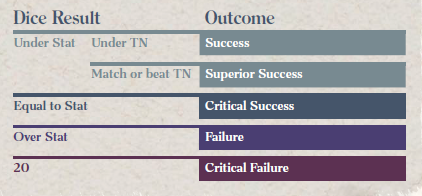
For stat tests, Hunters simply roll a D20 and compare the result to their stat. But for most rolls, there's also a Target Number that affects the degree of success, if a roll succeeds.
Stats make a much bigger difference to whether or not an action succeeds than the TN does, but the TN impacts whether a Hunter is more likely to suffer Resolve damage or to escape without damage at all - essentially, how lethal the attack really is. TN8 is relatively easy to soak; TN14 or higher is brutal. Set high TNs for stuff you want the Entity to be strong at, and lower ones for things it’s weak at. Here's how this plays out when a Hunter is defending themselves:
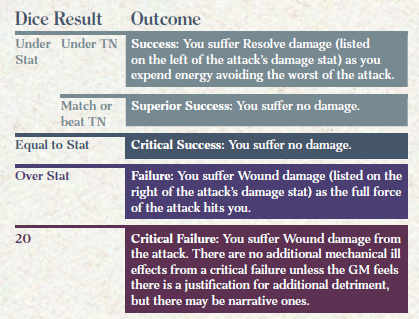
Every roll targets one of the Hunters’ five stats:
- Hard - taking a hit, endurance
- Quick - agility, getting out of the way
- Strong - brute strength, lifting, shoving, hitting
- Sharp - reaction speed, perception
- Wise - brainpower; usually used against deception or magic
[GRANT] I’m setting every single target number at 10. Normally I'd have a whole variety of ‘em, but I want to keep things as simple as possible for this exhibition game.
Health
Every Entity, like every Hunter, has two Health tracks.
- Resolve - courage, preparedness, stamina
- Wounds - physical bodily integrity
In general, Hunters work through Resolve health before they start inflicting Wounds in earnest (there are exceptions with some builds). Entities also get a fun “On Break” ability that happens when you run out of Resolve. This isn’t even my final form.
If you set the total Health to 20, then divide it between Resolve and Wounds, you won’t go far wrong. If you think your fight’s tougher than the average boss, increase Health accordingly. Entities with high Resolve are tough to break, but easy to kill once you get through the armour. Entities with high Wounds are stubborn. They don’t die easily.
For reference, Hunters do an average of 2 damage each turn, so you’ll want to give your monster some healing ability - either as a Manoeuvre (see below) or as a trigger when something exciting happens. We usually only allow Resolve healing, because Wound healing can feel frustrating, and also because it allows you to do that cool On Break ability multiple times, if you want.
While we’re on the subject, Hunters also have these two tracks, so all Entity abilities that inflict damage write them as X/Y, X being the amount of Resolve damage the attack inflicts, and Y being the Wound damage. A minotaur’s warcry and flailing swing of its club might be 3/2 - more frightening than it is harmful; a giant scorpion’s venomous sting might be 1/4 - a glancing blow or a grievous wound with no in between.
Hunters usually end up with somewhere between 5-8 in each track, by the way, so calculate your damage output accordingly: ideally they start dying in about round three of the fight, so outputting about 6 points of damage each round, divided between Hunters, is a good average.
[GRANT] I’ll give my lad 7 Resolve and 13 Wounds - pretty average.
Terrain
What the battlefield looks like. You get 6 pieces of Terrain, and you can make it Sheltered, Elevated, or usually a mix of both. Elevated helps Hunters with their attacks, Sheltered with their defence. This is also where you describe what the battlefield looks like (“towering hulks of rusted warships”; “sky-high pillars and incense-reeking alcoves of the temple to the Lord’s own vanity”), so the fight happens somewhere.
[GRANT] The World’s Lair game is set in Cartalhouse, the grimy capital of the Isles - basically Victorian London with the serial numbers filed off. Hollows draw on the obsessions of their victims and the world around them, so let’s think of somewhere suitably urban to set the fight. Maybe a decrepit train station, with a mix of 3 Sheltered (piles of mouldering luggage, fallen masonry) and 3 Elevated (rusted train carcasses, teetering walkways).
Doom
When a Hunter screws up badly outside a boss fight, it makes the entire Hollow salivate a bit, and get just a little nastier; that's represented by Doom. I’m telling you this so when you look at Entities other people have made (like the ones in the quickstart; did I mention the quickstart?), you’ll know what that section means. Don’t worry about it: you should only do Doom upgrades if you’re making a whole Hollow.
[GRANT] Yeah, same. I don’t need Doom for this.
Defences
Easy bit. How hard it is to hit the Entity:
- Close - melee range
- Ranged - archery and firearms
- Wyrd - with magic
See Target Numbers, above. We usually advise going with 12/10/8 (your choice where you put each value) for your first go. This is how that plays out when Hunters attack the Entity:
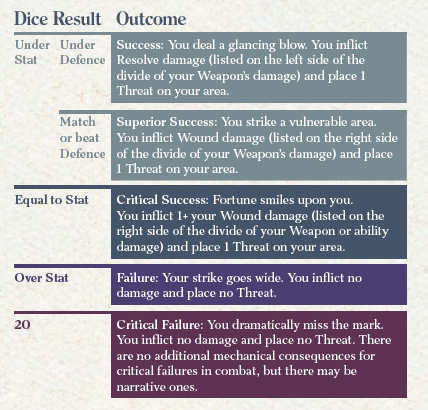
[GRANT] Let’s encourage the Hunters to get up close and personal: Close 8, Ranged 12, Wyrd 10.
Threat Per Round / Cap
How much Threat the Entity can put down at the end of each of its turns, and how much it can have on the map in total at the end of its turn (including any generated by Hunter attacks).
The main use of Threat is to power Interrupt attacks between Hunter turns. Most Interrupts cost 1 Threat (really good ones can cost more), and it usually has to be taken from the area the Interrupt is targeting, unless the attack specifies otherwise. If Interrupts are important to how the Entity works, give it about 3 Threat Per Turn so it can do its thing. If you want spare Threat to buff attacks, give it a high Threat Cap.
[GRANT] I imagine this guy as quite aware of his surroundings, in a mad terror sort of way. Let’s have 2 Threat in Close areas and 2 Threat in Ranged areas, which is plenty per turn, but ensures that it’s spread out so that I can’t pancake everyone in one go. We’ll set the cap fairly high at 15 because I don’t want to have to think about it when I’m running the show.
Specials
Any special rules that apply to this fight. Weird, unique conditions. They’re a fun way to handle passive abilities, or abilities with highly specific trigger conditions.
We often use these to track the effects of Curse. “If there is more than X amount of Curse in total areas, then…” If you put Curse in a fight, you’ll (probably) need to work out a way of removing it as well - either spending it yourself to do something nasty, having the Hunters make an action to clear it, or a combination or the two.
If you create more than three Special abilities, we find you’ll struggle to remember them all in combat.
[GRANT] Curse, yeah? We’ll have a few tricks that place Curse. When a Hunter has Curse, they can’t Guard on their turn. (Too scared to act sensibly. Fight or flight situation.) We also need a way of clearing it, and I wanted to play with the teamwork angle, so let’s say that as a Use manoeuvre, if you’re in an area with another Hunter, you can roll Wise; on a success, clear all Curse from one ally. (On a failure, clear 1. Let’s give them something for trying.)
Palpitations. Swollen with nameless dread, your heart feels as though it might burst. While a Hunter has Curse, they cannot perform the Guard manoeuvre on their turn. As a Use manoeuvre, a Hunter can test Wise; on a success, remove all Curse from an ally in their area. On a failure, remove 1 Curse from an ally in their area.
When Broken/First Broken
When an Entity is reduced to 0 Resolve, it is Broken. This can be good or bad. Generally, if getting Resolve down was a slog, something good (for the Hunters) can happen when they achieve it. Maybe the Entity’s Close defence is permanently reduced, because you’ve torn away its armour plating. If it was easy, something bad (for the Hunters) usually happens. Now the Entity’s spraying acid blood all over the battlefield, and so forth.
It’s entirely your choice whether to have:
- One big effect that fires only the first time the Entity is Broken
- A smaller effect that fires every time (just make sure you give your Entity a heal, if so)
- Both? Both is good.
[GRANT] I like the idea of the fight getting harder when you Break this thing, so let’s slap Curse on everyone not in Support when it first hits 0 Resolve. I’ll also put in a “second form” gag there where it does Curse on any damage after it first Breaks, to lend the fight a bit of texture.
I don’t need to have anything trigger on subsequent Breaks, I don’t think.
WHEN FIRST BROKEN. Shattered Psyche. It falls to its knees and the terror kept restrained in its head bleeds into your own. All Hunters not in Support gain 1 Curse. From now on, when the Entity inflicts damage to a Hunter alone in an area, they gain 1 Curse.
Interrupts
In most TTRPGs, the action economy massively favours the players. There are 4-6 of them and they each get a whole turn of actions. The monster gets one. It’s why boss fights are crap in many RPGs. In Hollows, as long as the Entity has Threat in the right parts of the map, it goes in between every player turn.
I hate to bring up the dragon in the room, but they’re a bit like Legendary Actions in 5e.
Interrupts are usually fairly weak attacks, inflicting about 2 points of damage. They often have minor special effects attached: they might Shift someone to another area, or the Entity might get a very small heal, or they might increment Curse. They all cost Threat. The default is 1, but we’ve gone up to 3. As a guideline, assume the cost is 1 Threat, and if you want an area of effect or multi-target, add 1. If you want a special effect that significantly shapes the monster’s tactics, add 1.
Most Entities have a choice of 2 Interrupts, but you can do as many as you fancy.
[GRANT] I love a 2/2 interrupt - it keeps the fight moving - but I want to push the Hunters into danger, and seeing as they might not be able to recover thanks to that Curse, let’s change it to 3/1, and it can set us up for a big Wounding attack later.
Panicked Swipe. A flailing hoof tries to dash your brains out. Cost 1 Threat. Target a Hunter in any Close area. Quick TN10, 3/1.
I also want a way to deal with Hunters who are hanging out in Ranged - I don’t expect this guy to have much in the way of long-distance damage - so let’s come up with something nasty that lets me move the little buggers around without necessarily doing much damage.
Terror Spike. A single beady eye catches your gaze and your head swims with fear that spurs you blindly forward. Cost 1 Threat. Target one Hunter in any Close or Ranged area. Hard TN10, 2/1. If this attack inflicts damage, you may Shift the target to an adjacent Close or Ranged area.
Attacks
You get one each turn. This is where you get to do really heinous shit. Most Entities’ main damage output is through their attacks. Default is one single target, high damage, and one multi-target with either lower damage or a trigger condition (“you can only do this to Hunters with Curse”; “costs 2 Threat to trigger”). Again, you can have as few or as many as you can keep track of. Samuel Mui wrote a lovely Entity that doesn’t attack, only reacts, in The Enlightenment of Alain Cooke.
Of course, there are more sophisticated ways to build your Entity engine, where the attacks are pretty minor but there’s a lovely interplay of Manoeuvres, Interrupts and Specials where - when the stars align - you can flatten three Hunters in one go.
Attacks don’t have to be one-offs. Chris Taylor has a real fondness for chain attacks, where if it causes damage, the attack repeats on a different target (sometimes with reduced damage… sometimes not).
I figure this guy’s using an improvised weapon - some sort of heavy railway detritus - and not a sword or something professional like that. Let’s follow Chant’s advice directly here. Two attacks, one big single-target, one multi-target that does less damage with some interesting side-effects.
Overhead Slam. It grasps the rusted spur of iron above its head in two shaking hands then brings it down on your skull. Target one Hunter in Front or either Flank. Quick TN10, 5/4.
Grand Sweep. It cries out, spittle flying, and lets rip with a backhand swipe hard enough to dislocate its shoulder. Target all Hunters in Front or either Flank. Hard TN10, 3/3. After this attack resolves, you may spend 3 Resolve to repeat it in an adjacent area.
Manoeuvres
You get one each turn. Or you can forego your attack and do two.
Manoeuvres are actions where the primary purpose isn’t causing damage: moving, healing, debuffing Hunters, or any other poisoned fruits of your imagination. Placing extra Threat is a fun one. So is manipulating Curse. So are little tricks that set you up to be perfectly positioned for the chain of attacks that will absolutely, guaranteed, kill at least one Hunter. I personally have done one where the Entity just hunkers down and gets harder to hurt for a turn (it’s fun, it gives the Hunters a break to reload and heal up, if they’re smart enough to realise it).
We consider it poor form to do damage in a Manoeuvre, because you have ample ways of doing that already, but it’s not against the rules.
Entities usually have two, but the sky’s the limit.
Every Entity has access to three default Manoeuvres as well as the ones listed in its stats. Grant and Chris put them in because it was annoying to have to write “move” and “heal” abilities for every Entity. And if it bored them, it’ll bore you. Save your Entity-specific Manoeuvres for “move and heal” or “heal more than the basic 3 points of Resolve”.
- Prowl repositions Hunters who fail a Quick test into an adjacent area
- Shrug Off restores 3 Resolve
- Turn Around repositions all Hunters one space clockwise or anticlockwise
[GRANT] Currently my lad has no recovery tech, so let’s build some in. Something that plays with the Curse from before, maybe?
Feeds On Fear. The more scared you are, the harder this thing is to kill. Target all Hunters not in Support. Test Hard; targets in Close roll with disadvantage. For each Hunter that fails, restore Resolve equal to their Curse+1.
It’s a bit risky, but it lets it spring back from that First Broken with a vengeance if the players roll badly. Plus, if one or two of them decide that they don’t need to clear the Curse because they don’t need to Guard on their turn, I can keep them around as unreliable Resolve batteries. While we’re on the subject of Curse, we’ll round out the Entity with a utility manoeuvre that plays with it:
Can’t Be Trusted. Your comrades look all too menacing in the skittering shadows cast by the creature’s lantern. Target a Close or Ranged area that contains one or more Hunters. All Hunters in target area test Hard. On a failure, choose 1:
- Target suffers Resolve damage equal to the highest Curse on a Hunter in their area.
- Target is Shifted to an adjacent Close or Ranged area.
- Target gains 1 Curse.
If the multi-target swipe wasn’t enough of a reason not to stand next to each other, Can’t Be Trusted should be. But they need to stand next to each other to clear that Curse! Which is how you get ‘em. And if they’re all grouped up nice and safe despite my attacks - maybe there’s an Armour/Spear user in there holding the fort - I can spread them out where they can’t help each other.
I’ll type this lad up as a proper Entity and put it at the end, so you can see it all in one place.
What Stands Between You and a Glorious TPK?
Nothing. You’re ready. Go forth and hurt them.
If you have questions, come to our Discord. There are people there who would like nothing more than to help you dream up nastily inventive ways to traumatise player characters.
If you want to see some existing Entities for inspiration, download the free Hollows quickstart here.
Go forth and make a monster. There’s a stat block template at the end of this post; you can download it, in .docx form:
Or grab it as a Google Doc here.
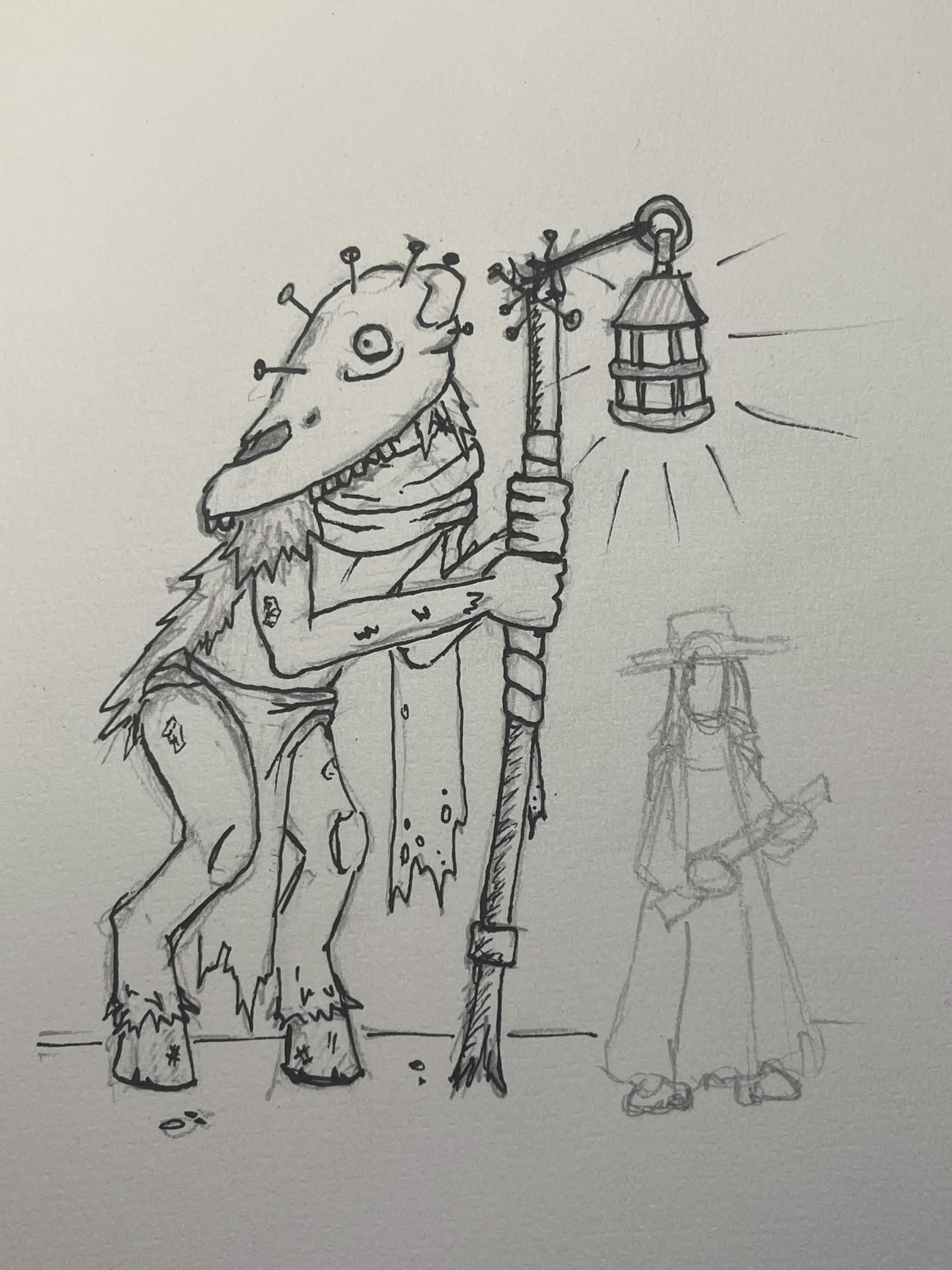
Equine Monstrosity
Horse-themed, terrified, lashes out and tries to murder you out of fear. Spreads that fear around the Hunters and grows more powerful the deeper it takes root.
Tactics
Don’t worry about doing anything terribly impressive until you’re first Broken, then go hog wild with the Curse; if the players let it build up, it’s useful healing for you as well as providing some casual damage output. Crucially, it also stops players from healing, so you’ll Break them more often, so they’ll die more often, which is nice. Explain to the players how to clear Curse, and when they feel clever for having done it, marmalise them with Grand Sweep and a side-order of Can’t Be Trusted if there’s some left.
Defences
Close 8
Ranged 12
Wyrd 10
Health
Resolve 7
Wounds 13
Threat
Threat Per Round 2 in Close areas, 2 in Ranged areas
Threat Cap 15
Terrain
An abandoned metropolitan transit station, all faded grandeur and tarnished glory. (3 Elevated, 3 Sheltered)
Special
Palpitations. Swollen with nameless dread, your heart feels as though it might burst. While a Hunter has Curse, they cannot perform the Guard manoeuvre on their turn. As a Use manoeuvre, a Hunter can test Wise; on a success, remove all Curse from an ally in their area. On a failure, remove 1 Curse from an ally in their area.
When First Broken
Shattered Psyche. It falls to its knees, and the terror once kept restrained in its head bleeds into your own. All Hunters not in Support gain 1 Curse. From now on, when the Entity inflicts damage to a Hunter alone in an area, they receive 1 Curse.
Interrupts
Panicked Swipe. A flailing hoof tries to dash your brains out. Cost 1 Threat. Target one Hunter in any Close area. Quick TN10, 3/1.
Terror Spike. A single beady eye catches your gaze and your head swims with fear that spurs you blindly forward. Cost 1 Threat. Target one Hunter in any area except Support. Hard TN10, 2/1. If this attack inflicts damage, you may Shift the target to an adjacent Close or Ranged area.
Attacks
Overhead Slam. It grasps the rusted spur of iron above its head in two shaking hands then brings it down on your skull. Target one Hunter in Front or either Flank. Quick TN10, 5/4.
Grand Sweep. It cries out, spittle flying, and lets rip with a backhand swipe hard enough to dislocate its shoulder. Target all Hunters in Front or either Flank. Hard TN10, 3/3. After this attack resolves, you may spend 3 Resolve to repeat it in an adjacent Close or Ranged area.
Manoeuvres
Feeds On Fear. The more scared you are, the harder this thing is to kill. Target all Hunters not in Support. Test Hard; targets in Close roll with disadvantage. For each Hunter that fails, restore Resolve equal to their Curse+1.
Can’t Be Trusted. Your comrades look all too menacing in the skittering shadows cast by the creature’s lantern. Target a Close or Ranged area that contains one or more Hunters. All Hunters in target area test Hard. On a failure, choose 1:
- Target suffers Resolve damage equal to the highest Curse on a Hunter in their area.
- Shift the target to an adjacent Close or Ranged area.
- Target gains 1 Curse.
Entity Stat Block Template
You can download a copy of this template here, in .docx form:
Or grab it as a Google Doc here.
Entity Name
Put your story and your description of the Entity here. Where does it live? What does its awful lair smell like? Why does it exist and why does it need to be put down immediately and with extreme prejudice?
Tactics
Explain your Entity’s engine to the GM. Tell them how to make best use of it. Does it hit really hard? Are you planning for it to Break every second turn? If it uses Curse, which abilities generate and spend it? What is the delicious kill move?
Defences
Close XX
RangedXX
Wyrd XX
Health
Resolve XX
Wounds XX
Threat
Threat Per Round X
Threat Cap X
Terrain
Fluff. X Elevated, X Sheltered.
There should be 6 pieces of terrain in total. You can vary that, if you have a reason to.
Special
Use these for passive effects or things the Entity can do on specific triggers. E.g. “When this Entity inflicts Would damage, it restores 1 Resolve.”
Name. Fluff. Effect.
When Broken/First Broken
Effect that occurs either the first time the Entity is Broken, or every time. If it’s first time only, make it a really significant event. Most Entities have one Broken effect.
Name. Fluff. Effect.
Interrupts
Stuff the Entity can do at the end of Hunter turns. Interrupts usually cost between 1-3 Threat, depending how powerful they are. Most Entities have about 2 Interrupts.
Name. Fluff. Cost: X Threat. Effect.
Attacks
Guess what these are. Most Entities have 2 or 3 attacks.
Name. Fluff. Target description (e.g. “one Hunter in Close”). Stat TNXX, X/X. Any special effects (e.g. placing Curse, Shifting the target around, etc.).
Manoeuvres
Useful actions the Entity can take during its own turn. They can cause damage, but it shouldn’t be the primary thing they do. Most Entities have 2 or 3 manoeuvres.
Name. Fluff. Target description. Effect.